Dream About War zone – Meaning
Category: Events & Situations
What this dream often looks like
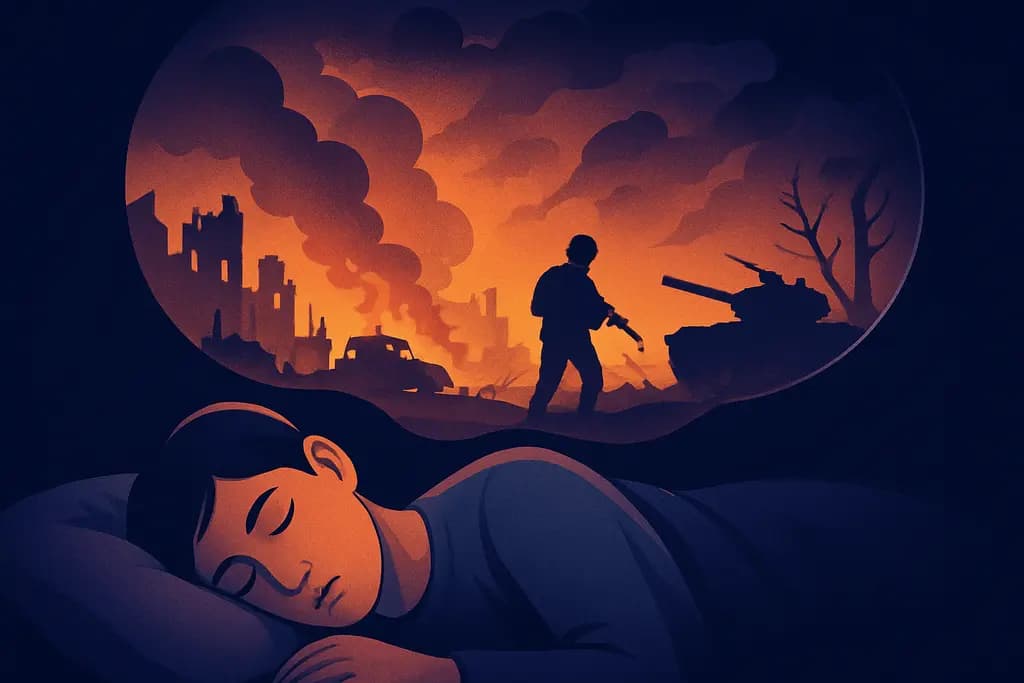
You wake with your heart racing, a deadline or argument still on your mind, then the scene opens: rubble-strewn streets, a burning municipal building, and the shock of running alongside strangers while orders bark over a megaphone. You smell smoke, your clothes are torn, and the feeling is acutely urgent — hunted, responsible, and flattened by noise. The setting is specific: a once-familiar neighborhood turned chaotic, a hospital corridor shuttered, or a workplace car park filled with smoke and shouting.
What this dream usually means
At its most direct, a war zone dream often signals that some area of your life feels under siege — professional pressure, a relationship breakdown, or a rapid transition that threatens stability. It can reflect actual interpersonal conflict or an internal state where competing priorities feel explosive. Interestingly, the dream tends to highlight who you see as ally or enemy, revealing where you feel powerless or how you’re gearing up to defend a boundary. It can feel paralyzing yet, at times, clarifying about where action is needed.
What this dream can point to in real life
- Conflict at work or in relationships. If the dream places you in offices, meeting rooms, or a neighborhood you recognize, it often points to external disputes: power struggles with a boss, a campaign of gossip, or split loyalties inside a family. The actors in the dream—coworkers who shout, a neighbor barricading a door—can map onto people exerting pressure. Look for scenes of negotiation turned hostile; they tend to identify specific relationships that need boundary-setting or clearer communication.
- Internal struggle, stress, and imminent change. When the landscape is chaotic but the combatants are blurred or you’re moving alone, the war zone can represent inner conflict: competing values, moral decisions, or anxiety about a big transition like a move, job loss, or breakup. The dream may rehearse fight-or-flight reactions, letting you experience fear, grief, or relief in a controlled way. It can suggest you’re processing loss or preparing yourself to act decisively.
What this dream usually does not mean
This dream rarely works as a literal prediction of physical violence or actual combat. It does not usually mean you will experience a real-world war or disaster. Instead, it commonly translates emotional intensity into battlefield imagery — a dramatic metaphor rather than a forecast. That contrast can feel jarring: the image is extreme but the meaning is typically symbolic, not prophetic.
Concrete details that tend to stand out
People often report the odd clarity of small objects: a child's red backpack lying in a classroom, a cracked office nameplate, distant artillery replaced by a single repeating siren, the metallic taste in the mouth, or the sensation of knees buckling as if your legs are full of lead.
Personal reflection prompts
- Where in my waking life have I recently felt besieged, undermined, or forced to choose a side?
- Which people in the dream felt like allies or enemies, and who do those figures match in my daily life?
- What one practical step could I take this week to reduce the pressure that the dream dramatizes?
Spiritual and symbolic perspective
Symbolically, some people experience the war-zone image as an inner spiritual crisis or a breaking down of worn structures that no longer serve growth. It can suggest a necessary purging of beliefs, a confrontation with shadow material, or a rite of passage where old identities fall apart to make room for new ones. This perspective is offered non-dogmatically: if it resonates, use it as language for inner transformation rather than a literal mandate.
FAQ
Is it related to stress?
Is it related to stress? Yes. These dreams are commonly linked to high stress or acute pressure—work deadlines, family conflict, or major life changes—that your brain translates into urgent, high-stakes imagery.
Why does this dream repeat?
Why does this dream repeat? Repetition usually occurs while the underlying conflict or decision remains unresolved; recurring dreams nudge you to address the same person, situation, or feeling until it shifts.
Why do I feel fear in this dream?
Why do I feel fear in this dream? Fear arises because the dream activates threat responses—loss of control, danger to identity, or the prospect of major change—and those emotions register as physical fear even when the threat is symbolic.
Related dreams to explore
If this dream keeps returning, pages about Alien Abduction, Attending a funeral, and Attending a Wedding as a Guest can reveal the related patterns underneath it. They often overlap around insecurity, transition, or stress in everyday life. You may also want to compare it with Being late to a wedding if the same mood or conflict keeps showing up.