Dream About Navigating a complex labyrinth or maze – Meaning
Category: Places
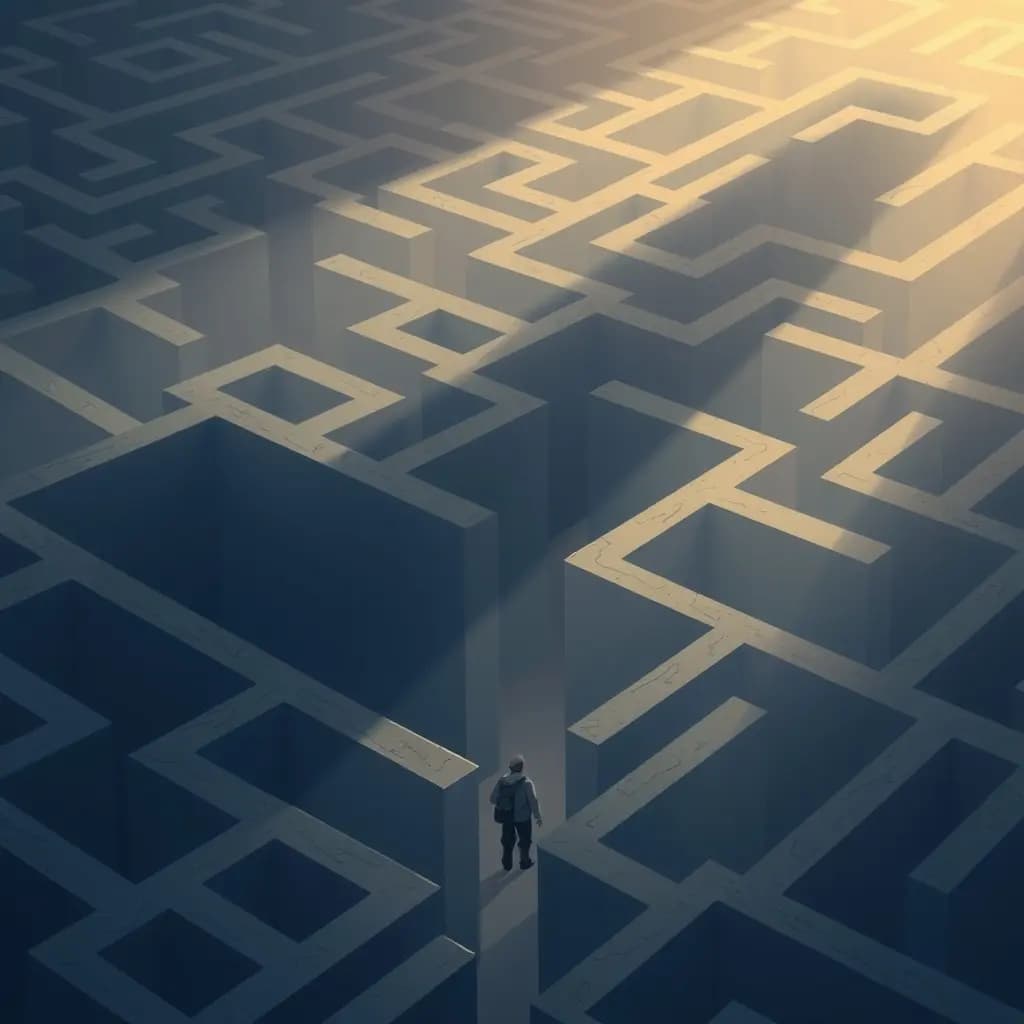
Dreaming about navigating a complex labyrinth or maze often points to a period of confusion, searching, or decision-making in waking life. Such dreams put you in a landscape of choices, turns and blocked paths — a mirror of inner or outer complexity. The precise meaning depends heavily on how you felt in the dream and the context around the maze.
General meaning of dreaming about Navigating a complex labyrinth or maze
A labyrinth or maze in a dream is a strong symbol of a journey — mental, emotional or life-directional. At its core this imagery represents complexity: multiple options, uncertainty, a need to make decisions and sometimes the sense of being lost. The experience may also highlight persistence, problem-solving, and the search for a central truth or goal.
Many interpretations overlap, because a labyrinth can be both a trap and a teaching structure. Often the dream invites you to slow down, examine choices and recognize which paths are habit and which are purposeful. Common core meanings include:
- Feeling lost or unsure about an important life decision.
- Working through complicated problems or inner conflicts.
- A rite of passage or a personal testing ground for resilience and patience.
- Hidden knowledge, inner exploration, or a quest for self-understanding.
- Obstacles and dead ends that require new strategies or perspectives.
Spiritual meaning of Navigating a complex labyrinth or maze in dreams
Spiritually, the labyrinth is a universal symbol of pilgrimage and inner transformation. In many traditions a maze is used as a walking meditation — the twists and turns draw attention inward toward a center, representing the soul's journey to wholeness. Jungian psychology treats labyrinth imagery as archetypal: a map of the unconscious where confronting complexity leads to integration.
Different cultures emphasize similar themes: the classical labyrinth as initiation, medieval cathedral labyrinths for contemplative prayer, and sacred geometry that points to an underlying order behind apparent confusion. In dreams this can signal a spiritual test, a call to contemplative practice, or a phase of energetic clearing.
Psychological interpretation
Fear, stress or anxiety
If the dream feels panicked, frantic or claustrophobic, it often reflects anxiety about being overwhelmed or unable to find a way forward. The maze becomes a metaphor for stressors that make you feel stuck — deadlines, responsibilities or looming choices.
Relationships and emotional bonds
When the maze context involves other people, it can highlight complex relational dynamics: miscommunication, difficulty finding common ground, or feeling lost inside someone else’s emotional landscape. It may also point to your search for intimacy or the fear of getting too close.
Control, power or vulnerability
A maze can represent loss of control or a sense of vulnerability — being at the mercy of circumstances or other people’s decisions. Conversely, successfully navigating a maze in the dream can reflect regained agency, improved problem-solving, and the ability to set boundaries and make clear choices.
Positive meaning
- Personal growth: navigating complexity can indicate you’re developing patience, resilience and strategic thinking.
- Breakthroughs: finding a path or center may symbolize new clarity, direction or creative insight.
- Healing and integration: the dream can mark emotional integration or a deeper understanding of yourself.
- Increased resourcefulness: learning to manage uncertainty and adapt to changing conditions.
- Spiritual progress: a step forward on an inner journey or awakening to deeper values.
Negative meaning and warnings
- May suggest unresolved issues that keep you circling without progress.
- Can indicate avoidance or procrastination — you might repeatedly choose circuitous paths to delay decisions.
- May signal overwhelming stress or burnout if the maze induces panic rather than focus.
- Can indicate confusing or manipulative relationships where boundaries are unclear.
- May suggest a need to change strategy rather than persisting with the same unhelpful approach.
Common variations of dreams about Navigating a complex labyrinth or maze
- Lost in a maze: You can’t find a way out and feel disoriented; this often reflects acute uncertainty about a major life decision or transition.
- Finding the center of the labyrinth: Reaching a center suggests clarity, inner peace, or a moment of insight after prolonged searching.
- Exiting or escaping the maze: Successfully leaving the maze can indicate resolution, regained control or the end of a difficult phase.
- Dead ends and blocked passages: Repeated dead ends may point to recurring obstacles, ineffective strategies, or the need to reassess priorities.
- A maze with shifting walls: When the environment keeps changing, it can mirror instability in your life — unpredictable relationships, job changes or shifting expectations.
- Locked doors or needing a key: This variation suggests specific barriers that require new tools, information, or permission to move forward.
- Guiding or helping someone through a maze: If you lead another person, it may reflect mentoring roles, taking responsibility, or having clarity others seek from you.
- Labyrinth in a familiar place (home, workplace): A maze set inside a known location points to complications or hidden issues within that area of life.
What to do after such a dream
- Reflect on emotions: Journal how you felt during the dream — confused, calm, hopeful, anxious — those feelings guide interpretation.
- Map your life situation: Identify current decisions, obligations or relationships that feel maze-like and list concrete steps to clarify them.
- Break big problems into small steps: Dead ends in the dream often mean you need a different tactic or smaller achievable goals.
- Seek perspective: Talk with a trusted friend, counselor or mentor to spot patterns you may miss alone.
- Practice grounding and stress management: Mindfulness, short walks, or breathing exercises help you think more clearly when facing complexity.
- Use creative problem-solving: Sketch a map, role-play outcomes, or try alternative approaches to see what changes.
- Watch for recurring themes: If the labyrinth dream repeats, consider deeper work — sustained introspection, therapy, or spiritual practice — to address persistent blocks.