Dream About Friends from Childhood – Meaning
Category: Relationships
What this dream often looks like
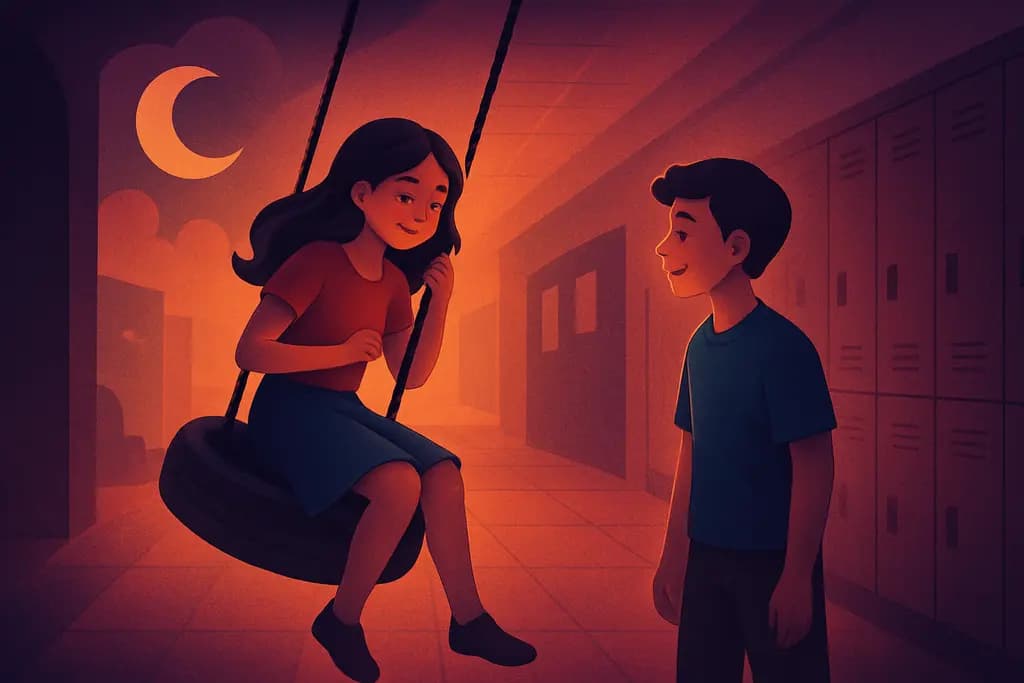
You are back in your old neighborhood at dusk: the streetlights halo the cracked pavement, a tire swing squeaks as someone pushes it, and your childhood friend stands by the garage holding a battered baseball glove. Your chest tightens with a mix of warmth and distance—smiling at first, then noticing a small argument you can’t quite hear. The smell of cut grass and the squeal of bicycle brakes feel so immediate you wake with the taste of metal on your tongue.
How this dream can be interpreted
- Nostalgia and identity. A childhood friend often stands for a past version of you: the fearless kid, the rule-breaker, or the peacemaker. When they appear happily playing or teaching you a game, it can suggest you’re reconnecting with traits you’ve shelved—spontaneity, creativity, or simpler priorities. Pay attention to the activity: climbing a tree may signal risk-taking you miss; sitting on the curb might point to comfort you crave.
- Unfinished business or guilt. If the scene includes an argument, apology, or a locked gate, the dream may be drawing attention to an unresolved interaction—something you didn’t say or a boundary that changed. This interpretation often surfaces when you’ve recently avoided a difficult conversation or made a compromise that still bothers you. The dream highlights what feels stuck and invites you to consider a practical, real-world step to address it.
- Current social patterns reflected. Sometimes a childhood friend appears because they embody a social role you’re navigating now: the leader, the critic, the loyal ally. Dreaming of them in a group or at a party can mirror how you move within your current social circle—seeking acceptance, fearing exclusion, or rehearsing old habits. Notice whether you follow or lead in the dream; that posture often replicates waking dynamics.
What this dream is not literally saying
This dream is rarely a literal prediction of reconnecting with that exact person or reliving the exact event. It does not usually announce a specific reunion, inheritance, or external consequence. Instead, treat it as language—metaphorical gestures and feelings pointing inward, not a forecast of concrete future actions.
Concrete details that tend to stand out
People report small, concrete images that linger: a classroom door painted bright green, the jingle of a rusty bicycle bell, rain starting mid-play, a lunchbox with a faded cartoon, or the sudden taste of bubble gum. You might notice your palms sticky from cotton candy or an echoing laugh that feels physically loud in your chest.
Spiritual and symbolic perspective
Symbolically and spiritually, a childhood friend may appear as a guide to a simpler truth or a marker along your soul’s timeline. In some contemplative frameworks they represent lessons you’ve mastered or qualities you’re being invited to reclaim—innocence, courage, or loyalty. This framing is non-dogmatic: for some, the figure feels like an inner mentor; for others, like a thread tying past and present. Use the image as reflective material rather than literal instruction.
What it can reflect emotionally
From a modern psychological angle, these dreams often reflect memory networks activated during sleep: familiar faces serve as anchors for emotional processing. They may surface during life transitions—starting a new job, becoming a parent, or ending a long relationship—when your brain re-examines formative social templates. This is not a diagnosis; it’s a sign your mind is sorting attachment patterns, role memories, and self-concept, sometimes bringing unresolved feelings into sharper focus so you can notice them in waking life.
Personal reflection prompts
- When did I last see or talk to this friend, and what changed in my life around that time?
- Which emotion dominates the dream—comfort, shame, longing, or something else—and where do I feel that emotion now (work, home, relationships)?
- What current person, situation, or habit mirrors the friend’s behavior in the dream, and what small step could I take to address it?
Frequently asked questions
Is it related to stress?
Is it related to stress? — Often yes: stress and life transitions activate memory and attachment networks, so childhood figures can resurface when you’re uneasy or overloaded. The dream points to emotional pressure, not a specific external threat.
Is this about relationships?
Is this about relationships? — It can be. Many of these dreams illuminate relational patterns—how you connect, withdraw, or rehearse old roles—but they don’t always refer to the actual person appearing in the dream.
Why do I feel fear in this dream?
Why do I feel fear in this dream? — Fear often stems from unresolved issues, perceived rejection, or the anxiety of repeating old mistakes. Physiological arousal during REM sleep can also amplify that fear, making past scenes feel immediate and alarming.
Related dream meanings
Dreams about friends from childhood are often connected to black Old Friends, dream about Old Friends, and Friends. Looking at those nearby themes can help you compare control, fear, pressure, or change across similar dream scenes. You may also want to compare it with many Old Friends if the same mood or conflict keeps showing up.