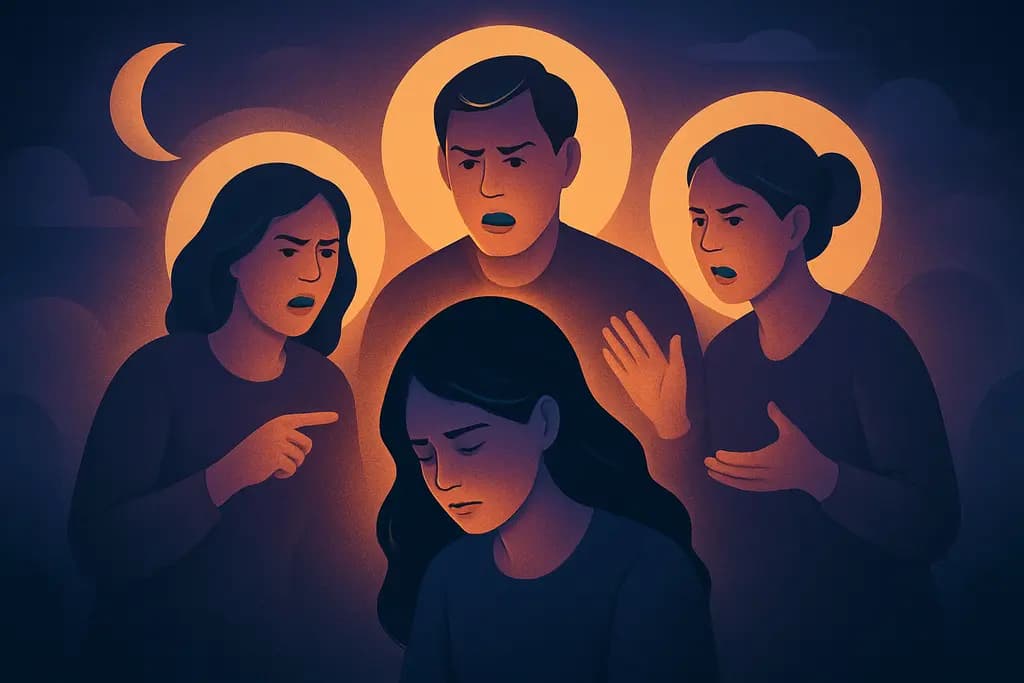
Dream About dream about being blamed by family – Meaning
Category: Relationships
Main interpretation
A dream where your family blames you commonly signals internal conflict about responsibility and fear of judgment rather than an actual pending accusation. If you’ve recently made a choice—missing a call, moving away, refusing a role in caregiving—the mind stages a confrontation to process guilt, expectation and the cost of boundaries. Practically, this dream may be telling you to notice where you accept blame too fast, to name what you owe versus what you carry alone, and to open a calm conversation with one trusted relative.
What it can reflect emotionally
In many cases, this dream reflects the mind’s way of rehearsing social threats: shame, anxiety about belonging, and the internalized voice of caregivers. It often emerges after a real-life argument, a missed promise, or extended stress like caregiving or financial strain. Psychologically, the scene helps you examine where you accept responsibility without negotiation and where fear of rejection drives your choices. It can feel humiliating yet oddly clarifying—revealing both the wound and a path to set healthier limits.
What this dream usually does not mean
This dream is rarely a literal prediction that a family member will accuse you tomorrow. It does not usually forecast specific future events; instead it stages emotional truth—shame, unmet expectations, or rehearsed conflict. Avoid assuming the dream maps a future confrontation; treat it as a signal about your inner pressures, not a script for what will happen.
Three common meanings
Internalized guilt and perfectionism. If you are hard on yourself after a mistake at work or home, the blame-dream can be an internal courtroom where your inner critic argues the case. Concrete triggers include missing a deadline, forgetting a birthday, or not meeting caregiving demands. The emotion is self-directed shame; the dream exaggerates blame to force you to notice patterns of perfectionism and self-punishment.
Unspoken family conflict or expectations. When tensions about roles—who cares for a parent, who takes the family business forward—are simmering, your brain stages a blame scene to process those demands. A recent family meeting, inheritance talk, or a pointed joke may appear as accusation in sleep. This interpretation highlights unresolved communication and the need to name expectations in waking life.
Fear of losing support or your place. If you’re undergoing a life change—moving out, changing jobs, starting therapy—the dream can reflect anxiety about being cut off or judged. Concrete signs: avoiding calls, hiding news, or rehearsing apologies. The core fear is losing approval or safety; the dream dramatizes eviction from the family circle so you can prepare boundaries or request reassurance.
Specific details people often mention
People often recall the room vividly: a dim living room with a single open door, rain streaking a window, a relative in a red jacket shouting, or the sound of a ticking clock and their own throat tightening until words fail.
When to take this dream seriously
Take this dream seriously if it recurs, appears during major life shifts, or follows sustained stress like job loss, caregiving burnout, or a breakup. Recurrence suggests the issue is unresolved; waking avoidance, chest tightness, or real-world arguments afterward heighten urgency. Useful next steps include journaling the exact accusations, naming one concrete boundary to try, and bringing a single concern to a trusted family member or counselor to see whether the dream mirrors real relational patterns.
How different traditions interpret it
Meanings vary across traditions and social contexts. Western psychological frames emphasize guilt and self-critique; some Asian interpretations focus on loss of 'face' and social harmony; certain Indigenous or ancestor-centered traditions might read the dream as a message from elders or unmet obligations to kin. Religious communities may interpret blame dreams in terms of sin or moral testing. Acknowledge this diversity: no single cultural explanation fits everyone, and local family norms shape how blame is felt and acted on.
Frequently asked questions
Is this about relationships?
Is this about relationships? Yes. It most often reflects relationship dynamics—expectations, criticism, and belonging—especially with parents, siblings, or caretakers rather than strangers.
Is this dream a warning?
Is this dream a warning? Not usually as a literal warning. It can signal emotional risks—strained ties or burnout—so treat it as a prompt to check-in, not a prophecy.
Is this about money?
Is this about money? Sometimes. If financial stress, inheritance questions, or dependence are present, money can underlie accusations, but money is one of several possible causes.
Can this dream be positive?
Can this dream be positive? Yes. It can motivate repair, clarify boundaries, or prompt honest conversations that improve closeness; the emotion of shame can catalyze constructive change.
Related dreams to explore
Dreams about dream about being blamed by family are often connected to Family, white wedding dream meaning, and Friends. Looking at those nearby themes can help you compare control, fear, pressure, or change across similar dream scenes. You may also want to compare it with Sex if the same mood or conflict keeps showing up.