Dream About Dancing – Meaning
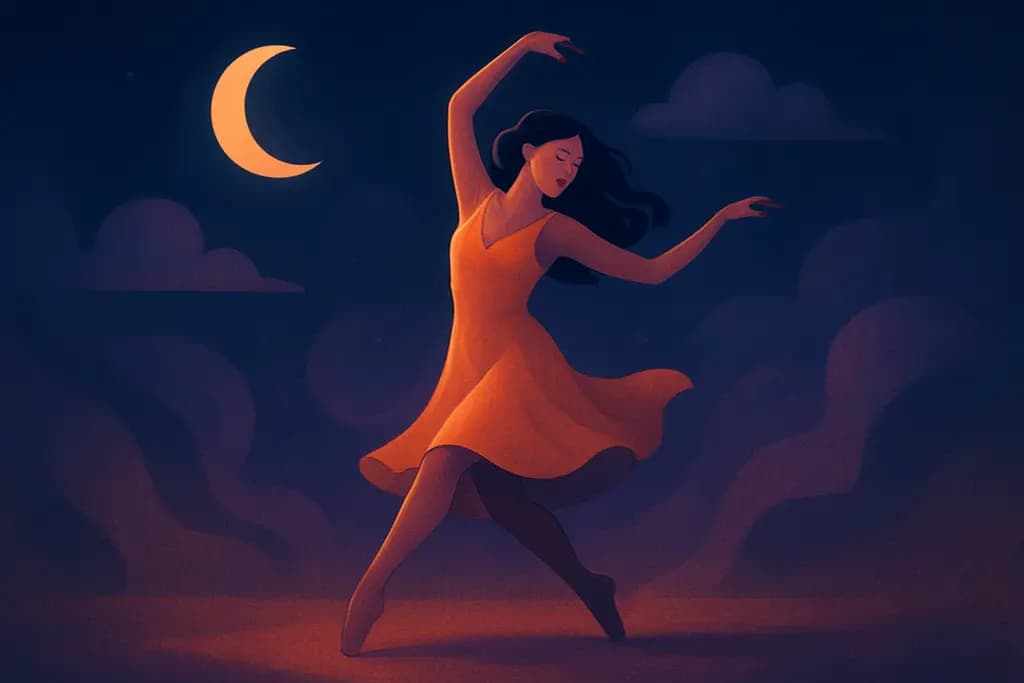
Category: Feelings
What this dream often looks like
You wake tight-chested after stepping onto a polished floor at a colleague's party, the fluorescent lights too bright and your coworkers clapping around you. Your shoulders are stiff from a day of meetings, but the music pulls you into a sequence of awkward turns. Sometimes it's a wedding ballroom where a missing partner leaves a gap; sometimes it's your kitchen, barefoot, spinning to a radio. The scene often feels charged — exposed, hopeful, or desperately trying to fit a role you play all day.
Concrete details that tend to stand out
People often remember precise imagery: a sequined dress snagging on a chair, rain suddenly pattering through an open skylight, the taste of metal when you breathe, muffled live piano from an adjacent room, or the sensation of your shoes slipping on varnished wood.
Three common meanings
Self-expression and release. When you dance alone or freely in a dream, it often points to a need to express emotions you've been holding back. The movements can be a rehearsal for speaking up, changing style, or making space for joy. Notice whether your face is relaxed — that ease suggests readiness to show your preferences in waking life; if tense, the dream may be inviting gradual practice rather than sudden change.
Performance and social anxiety. Dancing under bright lights or before an audience commonly reflects performance pressure: a presentation, parenting expectations, or social scrutiny. Awkward steps, forgetting choreography, or feeling judged by onlookers can mirror fear of being evaluated. This angle highlights where you're adapting behavior to fit others, and where reducing self-monitoring could lessen stress.
Transition and rhythm of life. A steady, changing dance sequence often symbolizes life shifts — moving cities, changing jobs, or the seasonal cycles of a relationship. The tempo of the music suggests pacing: fast music may mean rapid change, slow rhythms a deliberate transition. Paying attention to what you leave behind in the scene (a coat, a closed door) reveals practical steps you might already be taking or resisting.
Suppressed joy or unresolved longing. A dream in which you watch others dancing while remaining still can point to suppressed desires: wanting more spontaneity, intimacy, or recognition. The detail of being an observer rather than participant is a concrete emotional signal that something pleasurable feels inaccessible. This interpretation invites small, actionable moves — one spontaneous evening out, a creative hobby — to test whether the barrier is internal or external.
Spiritual meaning
Spiritually, dance imagery has long been used as a symbol for inner alignment, rites of passage, or communion with something greater. This reading treats the dream as a metaphorical movement of the self toward balance or release rather than a doctrinal message. Some traditions see dance as a language of the soul; others as a way to honor ancestors or communal bonds. Consider which symbolic tradition feels personally resonant, and treat the image as one map among many rather than fixed truth.
Psychological perspective
Viewed psychologically and non-medically, dancing dreams map onto role play, body memory, and emotional regulation. Movement in dreams can emerge from how you rehearsed behavior all day — a muscle memory of posture in meetings or the cadence of conversation at home. The dream often surfaces negotiation between private impulses and social expectations, showing where you feel competent, constrained, or curious. It’s useful to note which part of the body the dream focuses on — feet, hips, hands — because that part often correlates with the kind of action your mind is preparing for.
What this dream is rarely about
This dream is rarely a literal prediction of future success or an exact prophecy about relationships. It does not usually work as a literal prediction; instead it typically mirrors feelings about performance, intimacy, or timing. Emotional contrast is common: a dance that feels triumphant in the dream might still leave you unsettled afterward.
Personal reflection prompts
- Where exactly did the dance take place and who was present or absent?
- Were you leading, following, or watching — and how did that choice feel in your body?
- What real-life situation right now mirrors the tempo, coordination, or exposure in the dream?
FAQ
Is it related to stress?
Yes. Dreams of dancing are commonly related to stress when you feel judged, like before a presentation or social event; the dream often stages that pressure as choreography or performance anxiety.
Can this dream be positive?
Yes. These dreams can be positive — signaling release, celebration, or readiness to express yourself. A joyful, effortless dance often reflects growing confidence.
Is this dream a warning?
Not usually. While vivid, a dancing dream is rarely a literal warning; it more often signals emotional cues about relationships, timing, or stress than a specific future event.
Is this about money?
Usually not. Dancing in a dream does not typically predict financial outcomes; if money appears in the scene, it’s more likely symbolic of value, exchange, or worth than literal finances.
Related dreams to explore
People who dream about dancing often end up exploring Being Ignored, black climbing, and black crying next, because the same pressure can show up through different symbols. Comparing them usually makes the emotional pattern clearer. You may also want to compare it with black Riding a Bike if the same mood or conflict keeps showing up.