Dream About Unlabeled map – Meaning
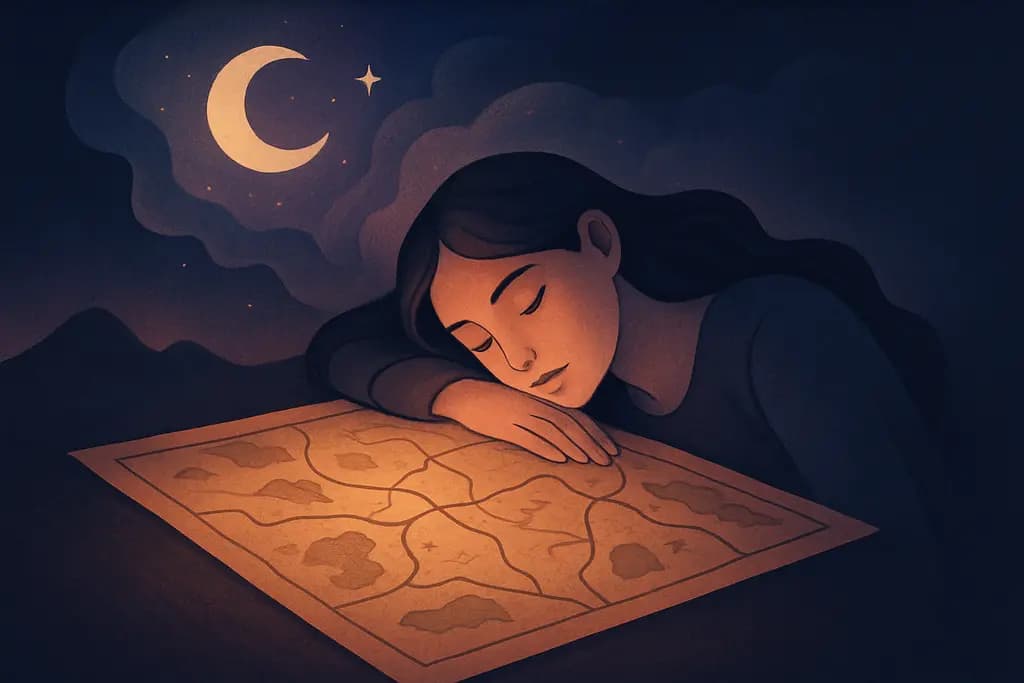
Category: Objects
Main interpretation
An unlabeled map in a dream commonly points to having a sense of direction without the usual markers: you can see roads and landmarks but not the names that anchor them. It often suggests you’re at a decision point where the structure is present but definitions are missing—career choices, identity shifts, or new relationships. How you felt in the dream—curiosity, relief, or anxiety—tends to color the meaning and signals whether you feel empowered to name your path or pressured by uncertainty.
A typical dream scenario
You’re bent over a spread of paper on a wooden table in a small train station, fluorescent light humming above. The coastlines and roads are clear, but every town name and road label has been rubbed away. Your thumb traces a river while your chest tightens—maybe you’re packing for a move, changing jobs, or deciding whether to end a relationship. The scene feels tactile: the map’s grain, the cool edge of the bench, the echo of distant announcements.
The emotional and symbolic message
Possibility and open direction. The unlabeled map can celebrate freedom: roads without names suggest options not yet defined. If you felt light or excited in the dream, it may reflect a readiness to invent your own route—starting a business, moving to a new city, or trying a creative project without following existing paths. The blank labels offer permission to name what matters to you.
Lack of guidance or missing information. If the dream came with anxiety or frustration, the unlabeled map may point to missing facts or mentors. You can see where to go but lack the signposts—like beginning a role without clear expectations, navigating family obligations, or making medical or financial decisions without enough information. The image encourages seeking clearer signs or asking for guidance.
Rewriting identity and personal narrative. An unlabeled map may also speak to identity work: familiar places appear but their names have faded, suggesting that labels you once used no longer fit. This reading often appears during midlife transitions, after a breakup, or when changing communities. The dream invites you to reconsider which names you keep and which you erase.
What this dream is not literally saying
This dream is rarely a literal forecast of a physical journey or a secret location to find. It does not usually mean you will literally receive a map or lose a labeled document. Instead, it commonly reflects internal states—ambiguity about choices or missing language for what you want—and should not be read as a concrete prediction.
Concrete details that tend to stand out
People often report small, specific images: a single locked door at the map’s edge, rain striking the paper, a child handing you a pencil, the distant rumble of a train, or the metallic taste in the mouth when you realize a city name is missing. Some remember clothing—an old coat or wet shoes—that anchors the mood.
How different traditions interpret it
Meanings vary across cultures. In many Western dream-interpretation traditions the unmapped terrain emphasizes autonomy or decision-making problems. Indigenous perspectives may read a map as land relationship and would focus on whose map it is and whether boundaries were altered. In some Eastern teachings the map can appear as a metaphor for mental states rather than physical places. Because traditions emphasize different values—community, lineage, inner insight—interpretations shift accordingly.
Personal reflection prompts
- What specific decision or area of life felt present in the dream (work, home, relationship), and which labels are missing now?
- What emotion dominated the scene—curiosity, fear, relief—and which small action could shift that feeling this week?
- If you could write three place-names on the map today, what would they be and why?
Common questions
Is this about relationships?
Is this about relationships? It can be. An unlabeled map often appears when relationship roles are unclear—dating without labels, shifting family duties, or ambiguous friendships—and may prompt you to name boundaries or expectations.
Why do I feel fear in this dream?
Why do I feel fear in this dream? Fear commonly signals missing information or pressure to choose. The absence of labels can feel like risk; your nervous system responds to uncertainty. Practical steps—research, questions, small tests—usually reduce that fear.
Is this about money?
Is this about money? Sometimes, but not always. If you’re making financial decisions (investments, job changes, moving), the dream can reflect unclear financial markers; otherwise it more often signals broader questions about direction or identity than specific monetary prediction.
Related dream meanings
Dreams about unlabeled map are often connected to Balloons, Bicycles, and Bikes. Looking at those nearby themes can help you compare control, fear, pressure, or change across similar dream scenes. You may also want to compare it with black lost objects if the same mood or conflict keeps showing up.