Dream About two Jumpscares – Meaning
Category: Fears & Nightmares
What this dream usually means
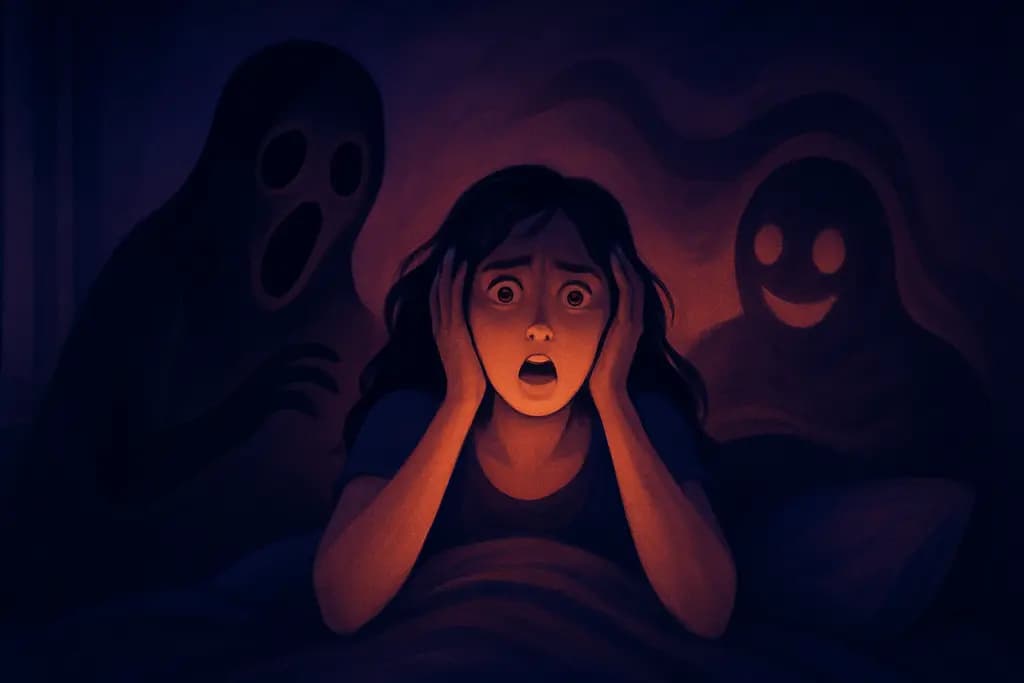
Two jumpscares most commonly signal stacked surprises or a repeated alarm from your subconscious. In many cases, the dream points to an initial shock (bad news, abrupt change, or boundary breach) followed by a secondary emotional hit (betrayal, guilt, or a consequence you didn't foresee). The twin shocks emphasize not just surprise but the way you process follow-up stress — whether you recover, brace, or spiral. Pay attention to who or what causes each scare; that pairing usually maps to two linked events or two sides of the same worry.
What your mind may be processing
From a modern, neutral viewpoint, two sudden scares in a dream often reflect a nervous system tuned to detect and rehearse threats. The sequence trains your brain: anticipate an initial surprise and prepare for additional hits. This pattern may arise when you are hypervigilant after a real-life shock — late work nights, a breakup, or health worries — and your mind rehearses both the trigger and the follow-up. The repetition helps you practice an emotional response; it may reduce surprise over time or keep you stuck in a startle loop depending on how you respond awake.
What this dream is rarely about
This dream is rarely a literal prediction of two separate physical events. It does not usually forecast exact occurrences like two car accidents or two job losses. Instead, the dream uses the mechanics of surprise — volume, timing, and repetition — to dramatize emotional patterns. Think of the dream as an emotional map rather than a timetable; it points to how surprises land on you, not to precise external outcomes.
Three common meanings
Stacked Stressors. The first jumpscare represents an immediate stressor — an email, a sudden argument, or an unexpected bill — and the second represents the cascading consequence: missed sleep, shame, or another deadline. This reading is useful if you've recently experienced two linked pressures at work, home, or in health. It suggests the need to address the follow-up problem, not just the initial shock.
Boundary Breach Then Betrayal. If people appear as the sources of both scares, the dream may be highlighting a relational pattern: someone crosses a boundary and then violates trust a second time. The doubling points to irritation that didn’t resolve — a comment that should have been addressed, then grows into resentment. Consider where you tolerated the first slight and how it let a worse reaction happen.
Memory Echo or Unprocessed Fear. Two jumpscares can replay a past trauma where one fright triggered another, or they can represent a present fear echoed by an old memory. The first shock is current; the second is the echo. If a sensory detail — a song, a smell, a specific room — links the scares, that connection likely traces back to an unprocessed event asking for attention.
Unusual details people report
People often report specific imagery: a flickering hallway light and a sudden figure at the stairwell, a car door slamming in rain then a second sound from the trunk, or two identical children in mismatched clothing appearing one after another. Heart racing, sweating palms, and the taste of metal are common body reactions in these scenes.
When this dream deserves attention
This dream deserves attention when it repeats, when the second scare feels worse than the first, or when it follows a real-life series of shocks (medical news, job upheaval, domestic conflict). Recurrence suggests an unresolved pattern: either a stressor hasn't been fully processed, or your nervous system remains on high alert. If the dream coincides with strong daytime anxiety, functional impairment, or flashbacks, consider structured support — a trusted listener, stress-management practices, or professional guidance — to break the startle cycle.
Symbolic meaning across traditions
Meanings vary across traditions. In many cultures sudden apparitions are interpreted as warnings from ancestors or spirit messengers; in others they are tests of courage or symbolic ruptures of order. Western cultural readings tend to emphasize anxiety and personal boundaries, while some indigenous or folk perspectives might read repeated scares as omens or community signals. Be cautious about certainty: cultural interpretations are shaped by local beliefs and personal context, so they offer different lenses rather than one correct answer.
Frequently asked questions
Can this dream be positive?
Yes. The dream can be positive if it functions as a wake-up sequence that helps you spot a pattern and take corrective action, or if the second scare prompts healthy change like setting boundaries or finishing a task.
Why does this dream repeat?
Repeating often happens when an issue hasn’t been processed or the nervous system is hypervigilant; the mind keeps rehearsing the shock and the follow-up until the emotional sequence is resolved.
What should I do after this dream?
Write down exact details, note who or what caused each scare, ground yourself after waking, and talk it over with someone you trust. If it recurs with daytime distress, consider structured support to process the pattern.
Why do I feel fear in this dream?
Fear in this dream comes from your brain’s startle circuitry and past associations: a sudden stimulus paired with an emotional memory creates a full-body reaction, which your dreaming mind then replays to make sense of it.
Dream meanings connected to this one
If this dream keeps returning, pages about black Jumpscares, dream about Jumpscares, and Jumpscares can reveal the related patterns underneath it. They often overlap around insecurity, transition, or stress in everyday life. You may also want to compare it with Jumpscares biting me if the same mood or conflict keeps showing up.