Dream About Twin or doppelgänger – Meaning
Category: People
What this dream often looks like
You find yourself in a familiar place — your childhood kitchen, a fluorescent office, or a crowded train platform — and suddenly someone else moves like you: same face, same clothes, same hesitant smile. The air feels thick; you touch your own arm to prove reality. Emotions are immediate and clear: curiosity when the double nods, alarm if it steps toward your partner, or a strange calm if it simply mirrors your every gesture.
Specific details people often mention
People often report seeing the double in a doorway, caught in a mirror, stepping out of a car, or standing across a crowded room. Specific sensory details appear: the double wearing a work jacket, a child’s raincoat, the sound of two synchronized breaths, a cold draft, or the clink of keys when the double reaches for your bag.
Quick interpretation
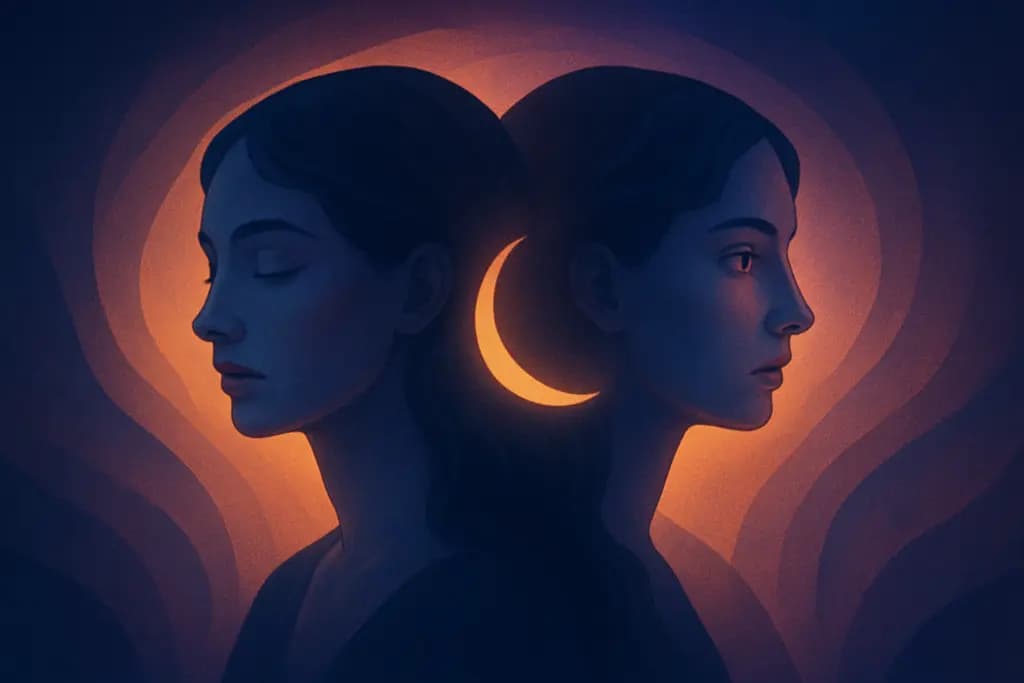
A twin or doppelgänger in a dream commonly represents a reflected part of you: qualities you acknowledge, deny, or are learning to accept. In many cases, the dream surfaces when you’re negotiating identity — making a choice, comparing yourself to someone, or noticing behaviors you dislike in yourself. The double’s behavior (friendly, hostile, indifferent) and your reaction give the quickest clues to whether the dream points toward integration, conflict, or fear of replacement.
Three common meanings
Mirror-self (integration of traits). The twin acts as your mirror: it models behavior you recognize but haven’t accepted. If the double is calm or helpful, this often points to a trait you’re ready to incorporate—confidence, assertiveness, or compassion. Noticing how you feel while watching or becoming the double shows whether you are resisting or starting to embrace that part of yourself.
Identity conflict or role split. When the dream feels tense or you’re arguing with your double, it often signals a split between roles you’re juggling—parent versus partner, professional versus creative self. These dreams commonly arise during decisions or transitions where you must choose which role to prioritize or how to blend them more honestly.
Fear of replacement or comparison. If the double looks like someone you know or a polished version of you and the dream triggers panic, the core theme is comparative fear: losing status, affection, or uniqueness. The double may symbolize someone you compare yourself to, or your anxiety that others will prefer the version of you you dislike or hide.
Hidden potential or untapped possibility. A friendly or distant double that points you toward a door, a suitcase, or a route you haven’t tried may represent capabilities you haven’t used. This version of the dream encourages exploration: try small real-world experiments that match the double’s actions—a new hobby, a different approach at work, or speaking up in one meeting.
Psychological perspective
From a neutral psychological angle, a double is a symbolic representation of parts of the self—actions, impulses, or roles not fully integrated into conscious identity. In many cases, these dreams emerge during periods of self-evaluation: comparing past and present behavior, deciding which habits to keep, or sensing internal contradiction. They function as mental rehearsal: you can observe, interact with, or confront the double to process emotions and rehearse new responses without real-world consequences.
What this dream is rarely about
This dream is rarely a literal prediction about another person appearing or being replaced in your life. It does not usually work as a prophecy. Instead of forecasting events, it typically reflects inner dynamics—identity, rivalry, or unacknowledged traits. That said, the dream can feel eerily factual; the emotional realism can create a temptation to read it as an omen, which is usually not helpful.
When this dream deserves attention
This dream deserves attention when it recurs, intensifies during transitions, or leaves you unsettled for days. Recurrence suggests an unresolved internal dialogue—perhaps a decision deferred, a role you avoid, or a trait you haven’t integrated. If the dream spikes during stress, major life changes, or after an argument, treat it as a sign to reflect and take specific small actions: discuss concerns, test a new behavior, or set a boundary you’ve been postponing.
Common questions
Why does this dream repeat?
Why does this dream repeat? Repeated dreams often point to an unresolved inner issue—an identity choice, a role conflict, or a suppressed trait that needs attention. Recurrence signals you haven’t yet processed or acted on whatever the double represents.
Why do I feel fear in this dream?
Why do I feel fear in this dream? Fear commonly comes from loss of control, comparison, or the uncanny recognition of parts of yourself you’re not ready to accept. The emotion flags what needs honesty or boundary work in waking life.
Can this dream be positive?
Can this dream be positive? Yes. If the double is cooperative or reassuring, the dream can indicate emerging strengths, growing self-acceptance, or readiness to step into a new role. It can feel empowering rather than threatening.
Is it related to stress?
Is it related to stress? Often. Stress, life transitions, and heavy comparisons amplify doubling dreams. Stress narrows coping resources, making internal conflicts more visible at night and more likely to appear as a doppelgänger.
Related dream meanings
Dreams about twin or doppelgänger are often connected to Doppelgänger (your double), Meeting your doppelgänger, and Seeing a doppelgänger. Looking at those nearby themes can help you compare control, fear, pressure, or change across similar dream scenes. You may also want to compare it with Seeing your doppelgänger or double if the same mood or conflict keeps showing up.