Dream About Traveling – Meaning
Category: Places
A typical dream scenario
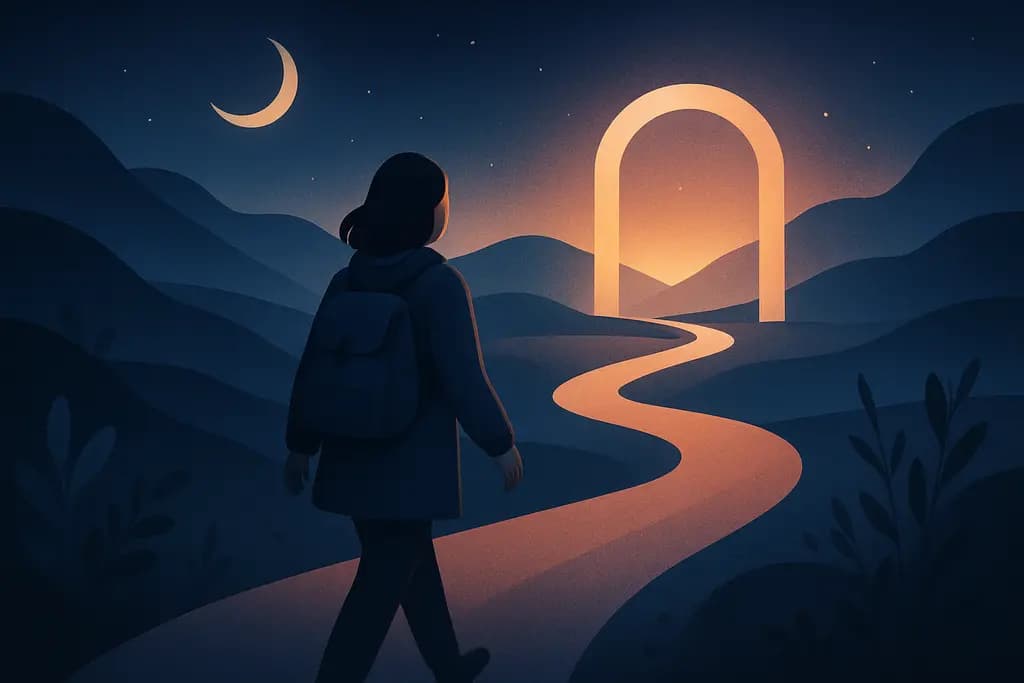
Direct answer: dreaming about traveling most commonly points to a transition—an urge to move, explore, or prepare for change. You might find yourself running to catch a bus at dawn, suitcase half-zipped, heart pounding with a mix of excitement and guilt; or sitting by a rainy airport window, hearing distant announcements while a familiar town recedes on a map. The scene usually feels active: departure, navigation, or arrival, and it often follows a real-life choice, new opportunity, or a recent ending.
Unusual details people report
People report small, specific images: a hallway you can’t find the door to, a taxi driver wearing an old uniform, rain that stops time, a suitcase that keeps getting heavier, the hum of an unfamiliar language, or the sudden feeling of floating in a crowded terminal. Some wake with their palms tingling or the taste of salt in their mouth.
Three common meanings
- Transition and Life Stage. Traveling symbolizes being between points: finishing school, changing jobs, or entering a new relationship phase. A slow, scenic journey can mean a deliberate transition; abrupt or forced travel suggests change happening faster than you anticipated. The dream highlights that you are moving from one identity or routine toward another.
- Decision and Direction. The route and choice of transport point to how you make decisions. Choosing a highway implies a clear, goal-oriented plan; getting lost on backroads may reflect uncertainty or fear about which path to take. Frequently, the dream asks which direction—practical, emotional, or creative—you want to pursue next.
- Exploration and Curiosity. If the dream feels open and curious, it often celebrates a desire to learn, travel, or expand horizons. Packing lightly or noticing unfamiliar landscapes suggests readiness to explore new ideas or cultures. This version of the dream supports experimentation and intentional novelty rather than escape.
- Escape and Avoidance. When the dream is frantic—running, missing connections, or hiding on a train—it can signal avoidance: trying to leave problems rather than address them. Repeated scenes of fleeing or refusing to arrive may point to unresolved obligations or fears you’re postponing rather than confronting.
Spiritual meaning
Seen symbolically, travel in dreams often marks a pilgrimage of the self—movement toward increased awareness or a new purpose. Some traditions read a journey as a rite of passage: the landscape represents inner terrain, and obstacles act as lessons. This is a non-dogmatic framing: the dream’s route can suggest a process of shedding old patterns and stepping into a broader sense of meaning or calling.
What your mind may be processing
In many cases, the dream mirrors how your mind models change: it stages practical details (routes, tickets) alongside emotions (anticipation, dread) to help you rehearse outcomes. Travel imagery lets the brain simulate decisions and potential losses—what you’ll leave behind and what you might gain. Think of the dream as an internal survey: it organizes options and feelings so you can try different responses without real-world consequences.
What this dream is not literally saying
This dream is rarely a literal prediction about an upcoming trip or exact outcome. It does not usually mean you will physically move the moment after you wake. Instead, it seldom functions as a calendar; it’s more about momentum or the sense of direction in your life. Emotionally, the dream can feel dramatic even when the waking change is small.
Questions to reflect on
- What specific part of the journey felt most charged—departing, traveling, or arriving—and why might that mirror a waking decision?
- Who else was with you in the dream, and what role did they play (guide, burden, stranger)?
- What small, practical step could you take this week to move toward the destination the dream suggested?
Common questions
Why do I feel fear in this dream?
Fear often appears because the dream simulates loss, uncertainty, or unfamiliar situations. Your mind tests boundaries—missing a connection or an unknown road creates adrenaline that registers as fear.
Is this about relationships?
Sometimes. Travel imagery can reflect relationship changes (moving in, breaking up, or shifting roles), but it can also be about career or personal identity. Look at who you were traveling with for relational clues.
Is it related to stress?
Yes, stress frequently shapes travel dreams. Deadlines, transitions, or overload can show up as missed trains or heavy luggage. The dream highlights how pressure affects your sense of direction.
What should I do after this dream?
Note the strongest image and one actionable insight—book a meeting, have a difficult conversation, or give yourself a day to explore options. Use the dream as a prompt, not a command.
Dream meanings connected to this one
If this dream keeps returning, pages about Bad Weather, Ballrooms, and black waterfalls can reveal the related patterns underneath it. They often overlap around insecurity, transition, or stress in everyday life. You may also want to compare it with Cave if the same mood or conflict keeps showing up.