Dream About staring into a black void or abyss dream meaning – Meaning
Category: Spiritual & Symbolic
Quick interpretation
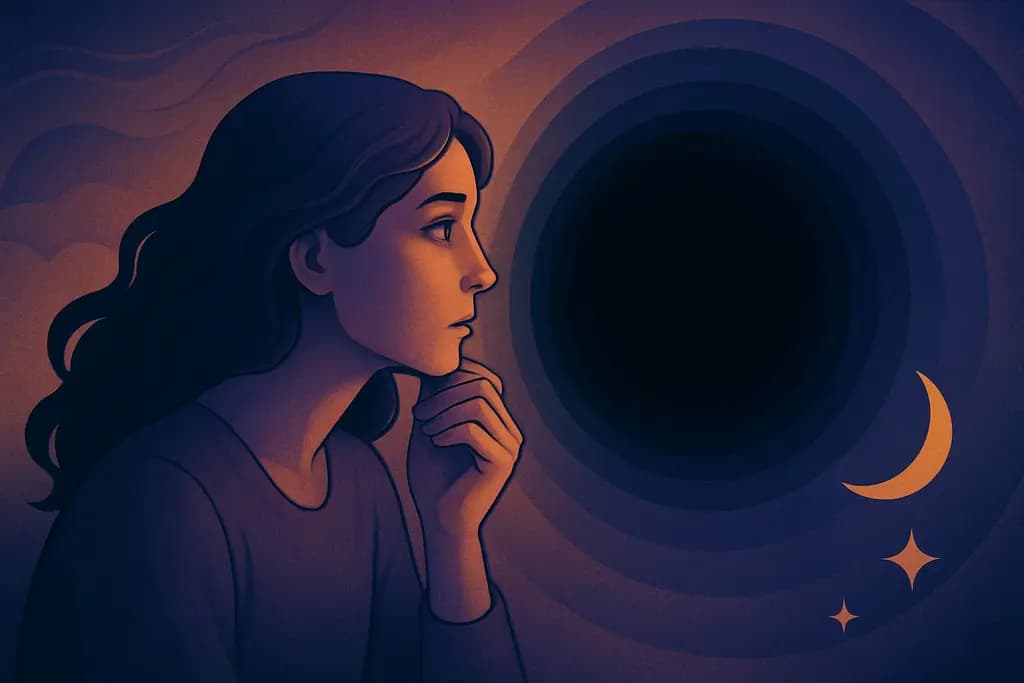
Quick answer: this dream most commonly represents facing the unknown—an emotional gap or threshold in waking life—rather than an external catastrophe. If you recently left a relationship, lost a job, or are deciding whether to move, the black abyss can stand for the unclear consequences you’re imagining: fear of failure, loss of identity, or a sense that a part of your life has ended. It often points to a need to name what’s missing and take small steps toward rebuilding rather than a literal prediction.
What it can reflect emotionally
From a contemporary, non-medical viewpoint, the dream can reflect threat simulation and attentional bias: when your brain is tuning for risks around a real-life change (a promotion, divorce, or medical news), it rehearses the worst-case scene—an endless drop. It also commonly surfaces when people feel decision paralysis or existential dread; the visual void is a simplified symbol for ambiguity, low perceived control, and rumination. The dream invites practical inventory: what choices are pending, what losses need closure, and which small steps reduce the sense of falling.
How this dream can be interpreted
- Existential uncertainty and life transition. When this dream appears after concrete events—ending a long relationship, moving cities, or leaving a steady job—it commonly maps the uncertainty that follows major change. The abyss stands in for options you can’t yet see: what career, identity, or daily routine will replace what’s gone. It may push you to acknowledge the magnitude of the change and take specific small actions (update contacts, draft a plan, schedule a meeting) to feel less suspended.
- Repressed feelings, grief, or avoided decisions. If you’ve been dismissing anger, sadness, or an uncomfortable choice, the black void can be the mind’s way of making that material visible. The darkness often corresponds to grief not yet processed—an unresolved apology, an unspoken goodbye, or debt of responsibility. This version nudges you toward a concrete task: write the unsent letter, make the phone call, or name the emotion to a friend or counselor so the abyss stops expanding in your inner life.
What this dream usually does not mean
This dream is rarely a literal prediction of doom or immediate physical danger. It does not usually Forecast concrete events. Instead of predicting death, disappearance, or a supernatural trap, it more often dramatizes an internal state—fear, loss of control, or a decision left unresolved. Emotionally it can feel apocalyptic, but that intensity is symbolic, not prophetic.
Concrete details that tend to stand out
Dreamers frequently notice a closed door beside the rim, a cold concrete stairwell leading nowhere, distant traffic sounds, a crowd watching in formal clothing, or the sudden sensation of numb toes and a ringing pulse. Sometimes there’s fog, rain against a metal railing, or a single bright object—like a red scarf—dangling above the dark.
When this dream deserves attention
Pay attention if the dream recurs, if it appears after a major loss, or if it follows escalating stress or avoidance. Recurring abyss dreams during a prolonged decision or after trauma often signal unresolved fear or the need for concrete steps toward healing—scheduling grief work, setting financial appointments, or establishing a daily routine. If the dream leaves you incapacitated in daylight—trouble sleeping, constant panic, or avoidance—reach out for support from friends or a trusted professional for practical coping strategies.
How different traditions interpret it
Meanings vary across cultures and belief systems. In some Western religious stories, darkness at the edge of a cliff can be associated with trial or temptation; in Jungian-influenced accounts the abyss is the shadow or the unconscious calling for integration. In Buddhist frameworks, an empty void may be interpreted as an encounter with emptiness (sunyata) that can lead to release rather than fear. Indigenous and folk traditions may read the scene through local symbols—thresholds, water, or ancestral presence. These interpretations differ widely and are shaped by cultural metaphors and ritual practices.
FAQ
Is it related to stress?
Yes. This dream is commonly related to stress—especially the stress of major change, uncertainty, or unresolved loss. It often surfaces during periods of high emotional load.
Can this dream be positive?
Yes. It can be positive if read as a threshold: an opportunity to release what no longer serves you and to create space for something new. It can mark the start of growth.
Is this dream a warning?
Not usually. The dream is rarely a literal warning about future physical events. It more often signals internal danger signs—unresolved fear, avoidance, or a need for decision-making.
Dream meanings connected to this one
If this dream keeps returning, pages about black butterfly emerging from a cocoon chasing me nightmare, white butterfly emerging from a cocoon dream meaning, and seeing a black void in a dream meaning can reveal the related patterns underneath it. They often overlap around insecurity, transition, or stress in everyday life. You may also want to compare it with two shadows acting on their own dream meaning if the same mood or conflict keeps showing up.