Dream About shadow acting on its own in the house – Meaning
Category: Spiritual & Symbolic
A typical dream scenario
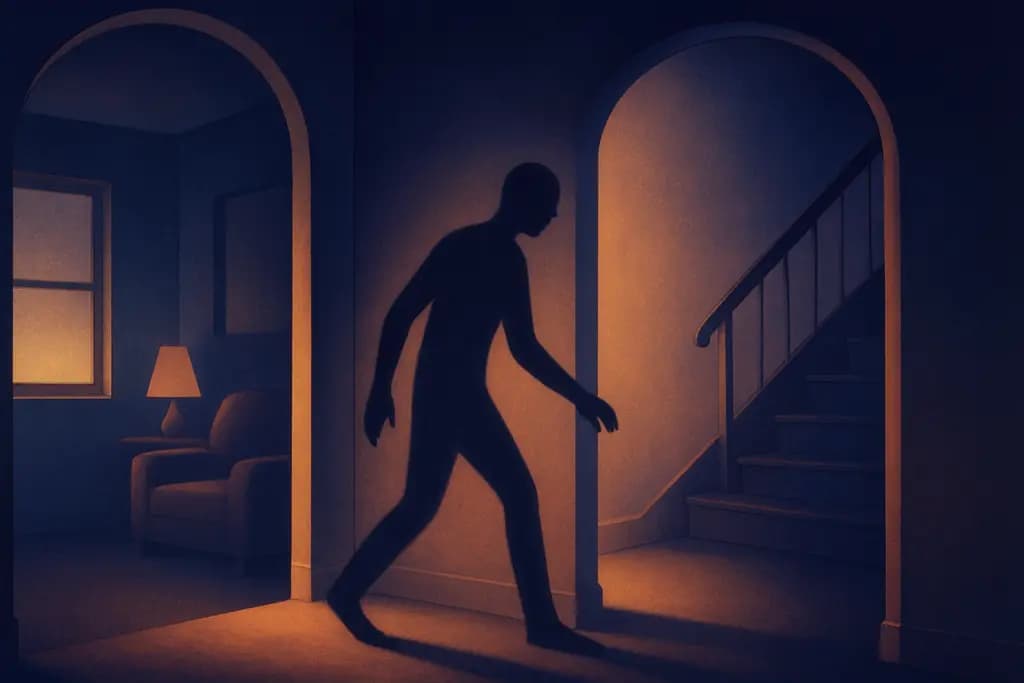
You go to bed already stretched thin—a missed deadline, an argument with a partner, or a child’s late-night fever—and wake inside the dream with a tight chest. In your house a dark shape slides across the hallway, slips under a closed bedroom door, and pauses at the top of the stairs. The light is low, the floorboards creak, and you feel both the urge to follow and the need to lock the door. The setting feels intimately domestic: a kitchen, an upstairs landing, a single lamp flickering.
Unusual details people report
Reportable moments include a shadow lingering at a closed bedroom door, sliding behind curtains in the living room, wearing old clothing, leaving muddy footprints, or making a soft scraping sound on stairs. People note physical reactions: hair rising on the back of the neck, a cold spot by a window, or the sudden urge to pick up a phone yet not dial.
What this dream usually means
A shadow acting on its own in your house most commonly signals a part of yourself or a private issue that feels active and independent of your conscious will. The house stands for personal life—rooms map to roles and relationships—so a roaming shadow often points to emotions, memories, or needs that are stirring beneath the surface and influencing behavior. In many cases, it calls attention to what you’ve pushed away: fear, anger, grief, or responsibility asking to be acknowledged.
Key interpretations
- 1. Shadow as disowned emotion. The shadow represents feelings you’ve set aside—anger after a heated conversation, grief you postponed for caretaking, or guilt from an unresolved choice. Seeing it move on its own suggests these emotions are no longer dormant; they influence your moods and decisions. If the shadow haunts a particular room, ask which part of your life aligns with that room: the kitchen for caregiving, the bedroom for intimacy, the attic for forgotten memories.
- 2. Shadow as boundary and autonomy issue. The autonomous shadow can point to boundary problems: someone else’s needs or expectations have become entangled with your sense of self. The house imagery highlights personal space—closures, unlocked doors, or open windows suggest where boundaries are weak. The dream may urge clearer limits: who gets access to your time, energy, or emotional life, and where you need to reclaim authority.
Psychological perspective
From a modern, non-medical viewpoint the dream stages an internal conflict: an aspect of self that feels separate and unpredictable. The house-as-psyche metaphor helps map inner life to physical rooms—basement memories, attic ideas, a locked bedroom for intimacy. This framing treats the shadow as informative, not threatening: noticing where it moves, what it does, and how you respond gives practical clues for therapy, journaling, or changing everyday boundaries and routines.
What this dream is rarely about
This dream is rarely proof that a house is haunted or that a supernatural event will happen; it does not usually work as a literal prediction. Rather than predicting an external event, it more often dramatizes inner tension. An emotional nuance: the scene can feel threatening without meaning actual danger to your home or safety.
When to take this dream seriously
Take this dream seriously when it recurs, intensifies during stress, or coincides with a life transition—moving house, a breakup, new caregiving duties, job loss, or a health scare. Recurrence often means the issue hasn’t been addressed: the same room keeps appearing, or the shadow’s actions escalate. If the dream is paired with waking changes in mood, disrupted sleep, or avoidance in relationships, it’s a practical signal to slow down, journal specifics, and talk with a trusted person or counselor.
Common questions
Why does this dream repeat?
Why does this dream repeat? Repetition usually means the underlying issue remains unresolved—unprocessed emotion, ongoing stress, or a boundary that hasn’t been enforced. The mind keeps returning to the image until action, recognition, or integration changes the pattern.
Can this dream be positive?
Can this dream be positive? Yes. It can signal awareness: a formerly hidden part is surfacing so it can be integrated. Meeting the shadow—naming the feeling or setting a boundary—turns disturbance into growth and increased self-knowledge.
Why do I feel fear in this dream?
Why do I feel fear in this dream? Fear often comes from uncertainty and perceived loss of control: a presence that acts on its own triggers an instinct to protect your private life. The fear is about internal disorder rather than immediate physical danger.
Is it related to stress?
Is it related to stress? Frequently. Stress lowers the threshold for subconscious material to reach awareness, so a looming deadline, caregiving load, or transition can make shadow imagery more vivid and active in dreams.
Related dreams to explore
People who dream about shadow acting on its own in the house often end up exploring shadow acting on its own in bed, shadow acting on its own attacking me, and white shadow acting on its own next, because the same pressure can show up through different symbols. Comparing them usually makes the emotional pattern clearer. You may also want to compare it with dream about staring into a black abyss and being pulled in if the same mood or conflict keeps showing up.