Dream About Seeing Your Doppelgänger – Meaning
Category: Spiritual & Symbolic
A typical dream scenario
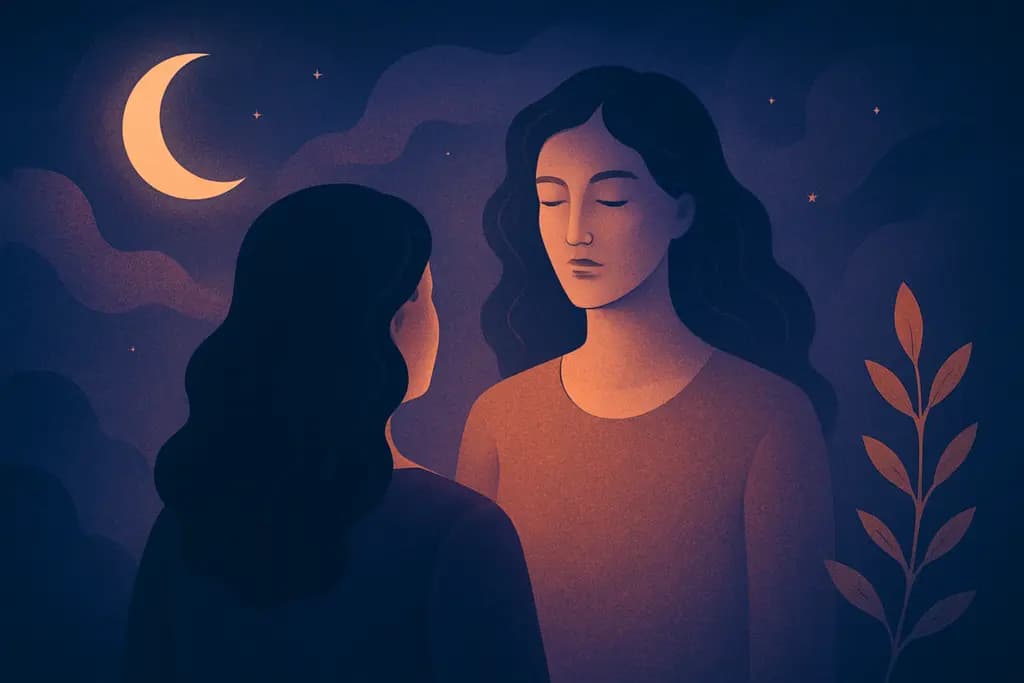
You’re in a familiar place — a dim kitchen at 3 a.m., the kettle hissing, or standing on a rainy street under a single lamp — when someone who looks exactly like you steps out from behind a doorway. Your heart jumps: sometimes you feel fear, sometimes curiosity. Maybe you’ve just started a new job, ended a relationship, or are deciding whether to move. In the moment the double’s face feels like a mirror that reflects a decision you haven’t consciously made.
Main interpretation
Interestingly, seeing your doppelgänger often points to encountering an aspect of yourself that’s been pushed to the background. This dream commonly reflects identity questions — who you are versus who you’re expected to be — or signals an impending role change, hidden impulse, or unresolved feeling. Pay attention to how you reacted in the dream; that emotion gives the clearest clue about whether the double is a threat, ally, or neutral mirror urging reflection.
How this dream can be interpreted
- Shadow and hidden traits. The doppelgänger can represent qualities you disown — anger you call selfishness, tenderness you call weakness, ambition you call greed. If the double acts secretive or hostile, it often signals a part of yourself you avoid acknowledging. Confronting that image in the dream can be the mind’s way of asking you to notice and negotiate those traits in waking life.
- Role change or identity shift. When you’re between careers, relationships, or life stages, the double may embody an emerging role or an older identity you’re leaving behind. If the dream felt surprising but not frightening, it can reflect curiosity about a new version of yourself; if it felt like loss, the double may be the part of you that resists change.
- Projection of conflict with others. Sometimes the doppelgänger functions as a stand-in for someone else — a partner, parent, or colleague — allowing you to explore tensions without direct confrontation. In this reading, the dream lets you rehearse responses, notice patterns you repeat, and see how much of the conflict actually comes from your own expectations or defenses.
- Integration and reconciliation. If the encounter ends with conversation or calm, the dream can signal a move toward integration: accepting a denied need or reconciling competing goals. A friendly double suggests acceptance; a negotiated parting implies you’re learning new boundaries. This interpretation often appears after intentional work on self-awareness or during therapy-like insight.
What this dream is rarely about
This dream is rarely a literal prediction of another person appearing or a supernatural omen of death. It does not usually work as a calendar-style prophecy. Instead, it most often symbolizes internal dynamics — a tension between public roles and private urges. Even when the image feels prophetic, treat it as a metaphor for choice or anxiety rather than a factual forecast.
Unusual details people report
People report small, vivid details: the double wearing an old school jacket, a cracked mirror behind them, a train’s whistle in the distance, damp pavement reflecting neon, or the uncanny sound of your own laugh. Body reactions like numb fingers or a sudden rush of warmth are common, as are crowded rooms where only the double is focused on you.
Psychological perspective
From a modern psychological angle, the doppelgänger is a symbol of self-reflection and internal contradiction rather than a supernatural event. It often surfaces when your self-concept is under stress — decisions, moral tension, or role conflict. Journaling what the double said, where you met, and how you felt can reveal recurring themes. Therapy or structured reflection helps unpack whether the dream points to automatic patterns to change, or adaptive traits you should reclaim.
Why recurring versions matter
Recurring encounters with your double deserve attention because repetition suggests an unresolved internal message. If the dream appears during prolonged stress, a life transition, or after a major change (move, career shift, breakup), it likely marks persistent identity work. Addressing it — through focused reflection, honest conversations, or creative expression — can reduce the dream’s intensity and help you move forward with clearer choices.
Frequently asked questions
What should I do after this dream?
Check how you felt and write the details: setting, clothing, words, and physical reactions. Use that record to spot patterns, then choose one small action (talk to someone, set a boundary, try a different routine) tied to the dream’s emotion.
Why do I feel fear in this dream?
Fear in these dreams often comes from facing denied parts of yourself or anticipating unwanted change. The emotion signals discomfort with something real inside or near your life, not an automatic threat.
Is this about relationships?
Sometimes. The dream can reflect relationship dynamics — unmet needs, mirrored behavior, or projection — but it more commonly reveals how you relate to yourself, which then shapes your relationships.
Dream meanings connected to this one
Dreams about seeing your doppelgänger are often connected to Seeing a Guiding Light, Seeing a Skull, and Seeing numeral sequences repeatedly. Looking at those nearby themes can help you compare control, fear, pressure, or change across similar dream scenes. You may also want to compare it with A blank map with no labels if the same mood or conflict keeps showing up.