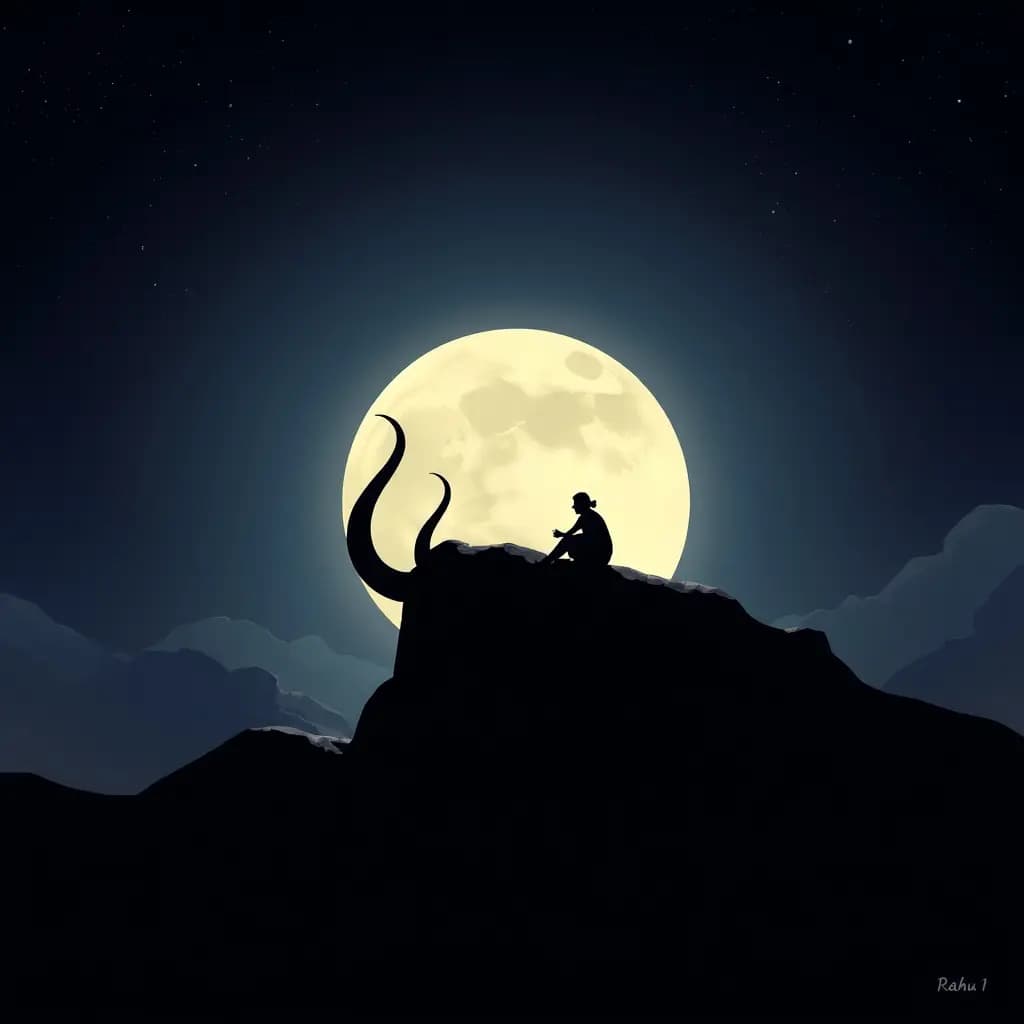
Dream About Rahu blocking moonlight – Meaning
Category: Moon & Vedic Astrology
A typical dream scenario
You stand on a third‑floor balcony at midnight, the city heat wrapped around your shoulders, and watch a brilliantly full moon go dim as a dark, shifting silhouette crosses it. Your chest tightens; you remember a missed message or a recent argument. The dream feels immediate—cool tile under your feet, a distant train whistle—and you wake with a lingering sense of being cut off from the calm you expected.
Concrete details that tend to stand out
People commonly notice small specifics: a silk scarf flapping on the balcony, a locked blue door down the street, the distant hiss of a rickshaw, the metallic taste in the mouth, sweat on the upper lip, or a sudden ringing in one ear. These concrete touches—clothing, vehicles, sounds and body reactions—tend to anchor the memory of the dream.
Key interpretations
- Emotional eclipse. The moon as emotion or inner calm is being temporarily hidden. This interpretation suggests you are suppressing sadness, grief, or tenderness—perhaps because a recent argument, a sudden breakup, or a workplace conflict forced you to harden your responses. The dream points to feelings that want recognition: a quiet way forward is naming the emotion in a journal or telling one trusted person what you’re afraid to admit. That small act can begin to restore the moonlight.
- Fixation and shadow fixation. Rahu in Vedic themes often signals obsession, illusion, or a fixation that takes over attention. Here, the dark figure may represent a thought loop—ruminating on a perceived slight, a reputation worry, or social anxiety—that blocks access to clear judgment. Practically, this can mean noticing the exact thought that repeats, reducing exposure to triggers (news, social media, particular people) and experimenting with brief distractions or grounding exercises to loosen the fixation.
Spiritual meaning
From a symbolic or spiritual angle, a blocked moon can invite a compassionate encounter with your shadow—parts of yourself you prefer not to see. Rather than a strict prophecy, the image often offers an inner ritual: pause, breathe, and ask what needs tending. Some people find quiet practices—simple moonlit walks, offerings of gratitude, or chanting—helpful to re‑align intention. Be cautious: spiritual frameworks vary; treat any practice as optional support rather than absolute truth.
What your mind may be processing
In many cases, this dream reflects how the mind simulates threat when it feels uncertain: blocking the moonlight mirrors how rumination or unresolved stress narrows attention and intensifies fear. Cognitive patterns like intrusive thinking, avoidance of uncomfortable feelings, or sleep fragmentation can produce vivid symbolic imagery. Notice the life events tied to the dream—an argument, deadline, or loss—and consider small steps (short breaks, clearer sleep routine, jotting morning impressions) to reduce the mental pressure that sustains the image.
What this dream is rarely about
This dream is rarely a literal prediction about the sky or an actual eclipse; it does not usually forecast an impending physical event. It also is not typically a straightforward message like 'someone will arrive' or 'you will lose X.' Instead, the image usually functions as a symbolic signal about feelings or attentional patterns, not a script for future events. There can be a bittersweet mix of dread and relief in recognizing that.
Personal reflection prompts
- When in the last two weeks did you feel a sudden cutoff from comfort or guidance, and what triggered it?
- Which recurring thought or person in your life most closely fits the image of a shadow crossing your emotional space?
- What one small action tonight could help you 'restore the moonlight'—a call, a note to yourself, or a five‑minute breathing practice?
Frequently asked questions
Is it related to stress?
Yes. Stress and acute worry commonly produce images of being blocked or cut off; the brain uses dramatic symbolism to flag emotional overload. Look for recent triggers like deadlines, conflict, or sleep loss.
What should I do after this dream?
Write down details immediately, note any recurring themes, and pick one small, calming action—switch off screens earlier, speak with a friend, or journal one page about the feeling. Simple steps reduce repetition.
Why do I feel fear in this dream?
Fear often arises because the moon in the dream stands for inner guidance; when that guidance is obscured your brain treats it like a threat. The body’s alarm response (racing heart, tight chest) can make the image feel especially frightening.
Why does this dream repeat?
Repeating dreams usually mean the issue hasn’t been resolved or the mind keeps rehearsing a scenario. Tracking when the dream appears and trying a small behavioral experiment often reduces recurrence over time.
Related dreams to explore
Dreams about rahu blocking moonlight are often connected to Moon wearing a crown, Moon phases on wristwatch, and Ketu whispering names. Looking at those nearby themes can help you compare control, fear, pressure, or change across similar dream scenes. You may also want to compare it with Rahu appearing at doorway if the same mood or conflict keeps showing up.