Dream About Protest march ignores you – Meaning
Category: Law & Authority
Quick interpretation
Quick interpretation: this dream often reflects feeling overlooked by a cause, group, or authority rather than a literal event. It can point to internal conflict about whether to join, lead, or stay separate; or to frustration that your values, efforts, or voice aren’t acknowledged. Interestingly, being ignored in the dream commonly highlights an internal choice—do you want recognition from that group, or do you need to reclaim your direction? The image calls attention to agency: the march carries collective energy while you evaluate your role in it.
What this dream often looks like
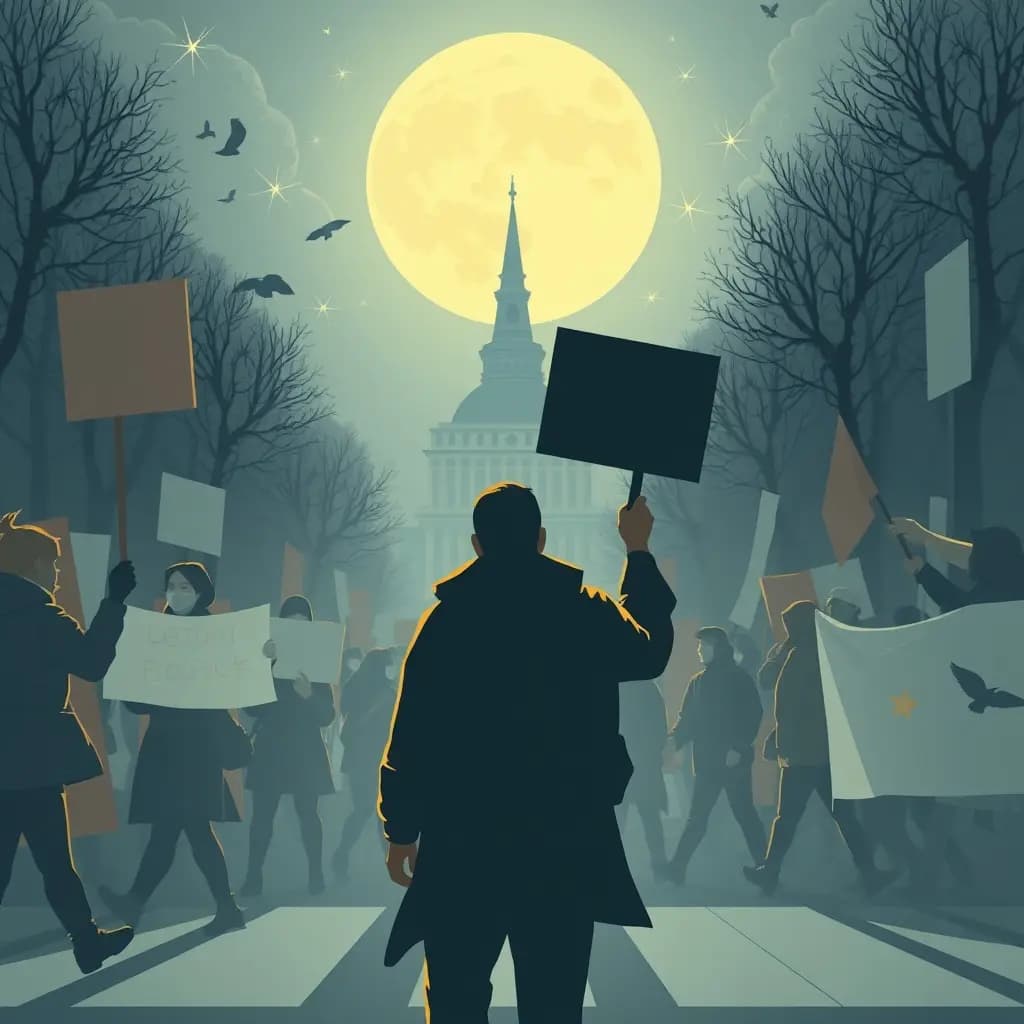
You stand on a rain-wet curb, clutching a coat, while a steady line of marchers moves past: hand-painted placards, a distant megaphone, the smell of coffee and damp pavement. Their chants form a distant rhythm that doesn’t include you. You feel a tightness in your throat—annoyance or relief—while city traffic blurs past and police cars sit idle at the corner. The scene is ordinary and charged at once: you are close enough to hear slogans but separated by a single block of indifference.
The emotional and symbolic message
- Social exclusion and visibility. This angle suggests you feel unseen within a group—at work, in a friendship circle, or in community activism. The march represents collective momentum; your position at the edge shows a sense that your contribution or identity isn’t recognized. The dream can push you to notice where you’re invisible and decide whether to ask for acknowledgment or step away.
- Moral or ideological disagreement. Here the march symbolizes a movement whose aims don’t fit your values. Being ignored may indicate you’ve distanced yourself from a group's ethics or tactics. The dream can be a prompt to clarify your stance: join, critique, or create an alternative that better matches your principles without forcing belonging.
- Fear of irrelevance or lost agency. The procession’s steady flow can feel like life events passing you by—career changes, social causes, or cultural shifts. The dream may reflect anxiety about losing agency or missing chances. Pay attention to whether the dream leaves you passive or determined; that emotional twist signals whether to reengage or protect your priorities.
- Desire for autonomy and boundary setting. Being ignored can be relief in disguise: the dream may reveal a wish to avoid group pressure and preserve personal boundaries. The march’s collective energy contrasts with your quieter needs. This interpretation suggests using the dream’s distance as permission to redefine involvement on your own terms.
What this dream is not literally saying
This dream is rarely a literal prediction that people will ignore you in waking life or that a protest will pass you by physically. It does not usually forecast a specific social event. Instead, it commonly signals an emotional boundary or value mismatch; the literal elements—crowd size, location, political signage—are symbolic more than calendar cues. An emotional contrast often sits under the image: anger and relief can coexist.
Unusual details people report
People often notice specific details like banners with half-read slogans, a red umbrella that keeps turning away from you, a delivery van braking nearby, or the cold bite on fingers. Some report buzzing cellphones, the taste of metal in the mouth, or the sound of shoes squelching on wet cardboard signs—small, sensory anchors that make the exclusion feel real.
Cultural and symbolic views
Meanings vary across traditions and communities. In Western psychological traditions the focus is often on individuality and boundaries; in collectivist cultures, being outside a group can carry stronger social consequences and might be read as a call to reconcile with community. Activist cultures might interpret the image as commentary on tactics or leadership, while religious traditions could frame it as prophetic marginalization or moral witness. Notice your cultural lens—what feels threatening in one context might feel liberating in another.
Questions to reflect on
- Where in my life do I feel like an observer rather than a participant, and what would joining or leaving look like practically?
- What values or phrases on the march would I disagree with, and how does that disagreement show up in my relationships or work?
- When I feel ignored, do I want recognition, or do I want to protect my boundaries—how would I act differently based on that choice?
Common questions
Why does this dream repeat?
Why does this dream repeat? - Repetition usually signals an unresolved feeling about belonging, values, or agency. Your mind keeps returning to the image until you try a different waking response—set a small boundary, speak up, or deliberately step back and observe.
What should I do after this dream?
What should I do after this dream? - Check where you feel overlooked or pressured in daily life. Pick one concrete action: ask for a meeting to express your role, decline one group demand, or journal about your values to clarify whether to join or withdraw.
Can this dream be positive?
Can this dream be positive? - Yes. It can be liberating: the distance from the march may reveal your autonomy or free you to build a more honest path. The key is noticing whether the dream leaves you energized or depleted and acting to align with that feeling.
Dream meanings connected to this one
People who dream about protest march ignores you often end up exploring Judge winks at you, Being served unknown papers, and Officer forgives you next, because the same pressure can show up through different symbols. Comparing them usually makes the emotional pattern clearer. You may also want to compare it with Judge ignores your testimony if the same mood or conflict keeps showing up.