Dream About Northern Lights – Meaning
Category: Nature & Elements
Main interpretation
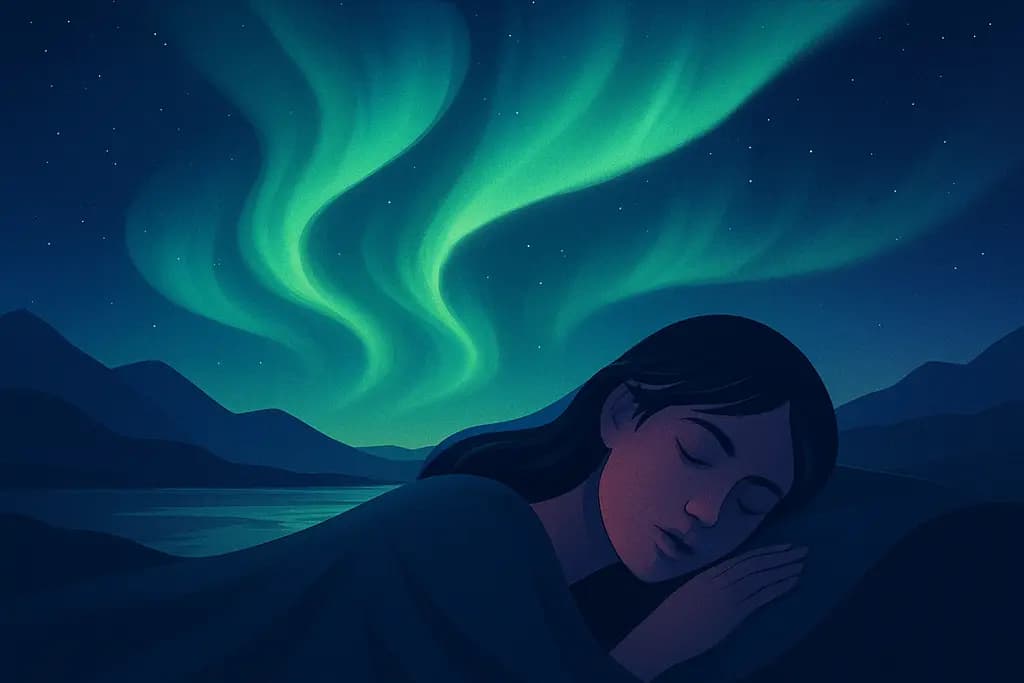
A Northern Lights dream commonly signals a moment of inner clarity, creative ignition, or a spiritual nudge rather than a literal event. If the aurora in your dream calmed you, it may point to reassurance or an opening; if it alarmed you, it can indicate unsettled change or feelings you haven’t named. Pay attention to where you stand in the scene and who else is present—those details help locate whether this is personal insight, inspiration, or a signal to prepare for transition.
A typical dream scenario
You are standing on a frozen shoreline or a hilltop at night, shoulders tight against the cold, breath visible in front of you. Above, curtains of green and purple light unfurl and shift, sometimes close enough to feel a soft electric hum; sometimes they stay distant. You might be alone or with one person who watches in silence. The immediate feeling—wide-eyed wonder, smallness, relief, or a prickle of dread—colors the dream and lingers after you wake.
Unusual details people report
People often report odd specifics: a wooden door behind them that they can’t open, a child in a bright red coat pointing, a distant engine noise, or the taste of metal on the tongue. Some feel their hands vibrate or notice unusual clothing like fur boots or a military jacket during the scene.
Emotional and symbolic meanings
- 1. Inner guidance and clarity. The aurora can act like an inner lighthouse: a sudden stripe of color that highlights a truth you’ve been avoiding. This interpretation fits if you wake with a sense of understanding or relief. The lights may point to a new perspective on a relationship, a job decision, or a personal value that needs attention.
- 2. Creative awakening and inspiration. When the dream leaves you with awe or a rush of possibility, it often signals creative energy stirring. Writers, artists, and people facing problem-solving challenges commonly report feeling energized after such dreams. The aurora’s shifting shapes mirror ideas assembling—follow that momentum into small, concrete experiments.
- 3. Transition, endings, and emergence. If the lights accompany a sense of cold, distance, or loss, the dream may reflect an ending that makes room for something new. The aurora’s ephemeral nature can mirror grief, closure, or the threshold before a life change. It may encourage you to honor what’s ending and prepare practically and emotionally for what follows.
What this dream is rarely about
This dream is rarely a literal forecast of geographic or meteorological events and does not usually work as a literal prediction of future occurrences. It should not be read as a straightforward omen that something external will happen exactly as seen. Emotion matters more than visual accuracy; the aurora’s mood in the dream is usually symbolic, not an event timetable.
Symbolic meaning across traditions
Meanings vary widely across cultures. Arctic Indigenous communities have longstanding stories linking aurora to ancestors, messages, or moral lessons; Norse and Scandinavian lore sometimes viewed them as signs connected to gods or warriors. In contemporary urban contexts, people often read them as aesthetic or psychological symbols. Respect cultural origins and avoid imposing a single interpretation—the same image can be ancestral, mythic, artistic, or personal depending on background and belief.
Questions to reflect on
- Where were you standing in the dream and who, if anyone, stood beside you—how does that map onto your waking relationships?
- What emotion stayed with you after waking (awe, fear, curiosity, relief), and where in your life do you already feel that?
- Is there a small, tangible step (a conversation, a creative test, or a practical plan) you can take this week that follows the dream’s energy?
Frequently asked questions
Is it related to stress?
Is it related to stress? Many people who dream of auroras are processing change or tension; the lights can appear when your mind is handling stress or making sense of a major decision. The key is the dream’s tone—calm suggests resolution, agitation suggests unresolved stress.
Is this about money?
Is this about money? Generally no; the Northern Lights more commonly point to meaning, creativity, or emotional shifts than to literal financial gain. If economic concerns were prominent in the dream’s context, treat money as one possible but not primary layer.
What should I do after this dream?
What should I do after this dream? Note the dominant emotion and one vivid image, journal about them, and pick one practical next step that mirrors the dream (start a creative draft, have a clarifying conversation, or plan for a transition). Small action helps translate insight into change.
Is this dream a warning?
Is this dream a warning? It can feel like a warning when it unsettles you, but it seldom functions as a precise cautionary signal. More often it points to internal adjustments needed—emotional readiness, creative choices, or relationship boundaries—rather than an impending external disaster.
Dream meanings connected to this one
Dreams about northern lights are often connected to A lighthouse whose light goes out, A river made of glass, and A tree that speaks to you. Looking at those nearby themes can help you compare control, fear, pressure, or change across similar dream scenes. You may also want to compare it with An unreachable fruit on a tall tree if the same mood or conflict keeps showing up.