Dream About Locust swarm – Meaning
Category: Animals
A typical dream scenario
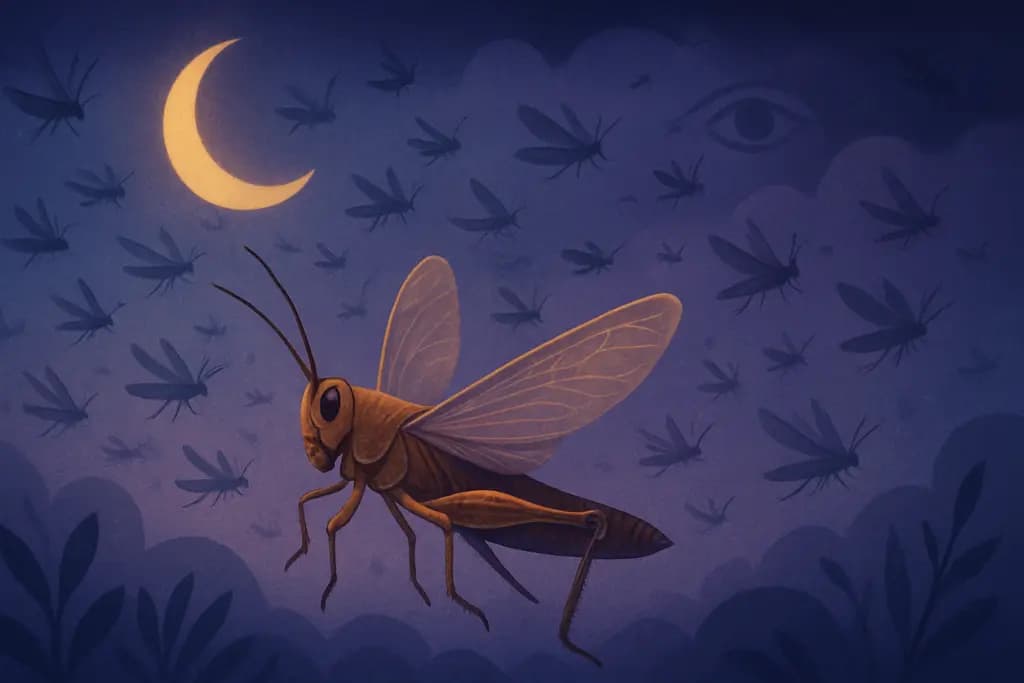
You’re on a second-floor balcony watching late-afternoon light when a dark wall moves across the valley — not birds, but a thick cloud of locusts that muffles sound like heavy rain. They sweep through the garden, strip the tomato plants bare and tumble into an open window where family photos sit on the sill. Your chest tightens, you slap at your shirt to brush them off, and for a moment you imagine your savings, time, or energy vanishing as fast as the leaves.
What this dream usually means
Direct answer: a locust swarm in a dream commonly signals rapid loss, collective pressure, or a sense that something fundamental you rely on is being consumed. It often points to financial depletion, emotional exhaustion, or a sudden change that feels bigger than you — a job layoff, a breakup spreading through social circles, or responsibilities piling up. Interestingly, it can also indicate a forced clearing: what’s taken may make room for a different structure or priorities after the shock subsides.
Three common meanings
- Mass loss or depletion. A swarm often symbolizes rapid consumption of resources — money, time, energy, or reputation. If you’ve been stretched thin by caregiving, overtime work, or repeated financial hits, the dream reflects the experience of having essentials taken faster than you can replace them and the panic that follows.
- Collective pressure or social forces. Because locusts move as a group, the dream can point to crowd dynamics: workplace demands, social-media attacks, family expectations, or cultural shifts that feel unstoppable. It may highlight anxiety about being swept along by decisions you didn’t make, or fear that a community change will erase what you value.
- Boundary erosion and vulnerability. Locusts entering private spaces — bedrooms, kitchens, cars — often mark violated boundaries. The dream may name situations where your privacy, limits, or personal projects are ignored. Expect a focus on restoring boundaries or deciding which relationships or obligations to restrict.
- Cleansing and necessary endings. Sometimes the swarm signals a harsh but clearing ending: an old routine, career path, or relationship consumed so new growth is possible. This interpretation points to loss as a reset that forces prioritization. The emotional register here can be grief mixed with reluctant relief.
What this dream usually does not mean
This dream is rarely a literal prediction of famine, national crisis, or a supernatural plague. It does not usually mean an actual agricultural disaster is imminent. Instead, the image functions metaphorically to dramatize depletion or pressure. Emotionally, the dream can feel apocalyptic even when the waking problem is a contained but urgent loss.
Concrete details that tend to stand out
Dreamers often recall locusts pouring through a cracked door, filling a kitchen sink, sticking to wet clothes, or masking the sound of engines on a highway. The wings make a papery static that sets teeth on edge; a single yellow raincoat or a child’s toy among the swarm can linger in memory.
Psychological perspective
From a contemporary psychological angle, a locust-swarm dream is a vivid metaphor the mind uses to encode stressors that feel large, rapid, or collective. It often emerges when cognitive load is high or control is low: the brain dramatizes depletion to draw conscious attention to problems you’re minimizing. Rather than indicating pathology, the image organizes anxiety into a single, memorable scenario so you can plan — conserve resources, set limits, or seek social support.
When this dream deserves attention
Pay close attention if the dream repeats, follows a major life stressor, or leaves you with lingering fear. Recurrence suggests an unresolved issue — repeated boundary violations, ongoing financial strain, or slow-burning grief. If it appears during a life transition (moving, career change, new parenthood), use it as a prompt to inventory losses and protections. Practical next steps include tracking triggers in a dream journal, setting small boundaries, or consulting a trusted friend for perspective.
FAQ
Is this dream a warning?
Is this dream a warning? Not usually a supernatural warning, but it can serve as an urgent signal that something important is being depleted — your energy, finances, or boundaries — and that immediate attention is needed.
What should I do after this dream?
What should I do after this dream? Take practical steps: list resources being strained, set one small boundary, check budgets or schedules, and talk it over with someone who knows your situation for realistic next steps.
Can this dream be positive?
Can this dream be positive? Yes. While frightening, it can also mark a forced clearing that enables necessary change: shedding obligations, simplifying life, or redirecting energy toward what matters most.
Related dream meanings
If this dream keeps returning, pages about Alligators, Animals, and Ants can reveal the related patterns underneath it. They often overlap around insecurity, transition, or stress in everyday life. You may also want to compare it with Bats if the same mood or conflict keeps showing up.