Dream About Jumpscares dream meaning – Meaning
Category: Fears & Nightmares
What this dream usually means
A jumpscare dream most commonly signals an unresolved shock or an alarmed boundary: it often reflects a recent unexpected event or a simmering fear that finally broke through your conscious defenses. This dream can reflect being startled by news, an intrusive memory that returns without warning, or a sense that someone crossed a personal limit. It’s commonly associated with heightened vigilance and the mind’s attempt to process what felt sudden and threatening.
Psychological perspective
Viewed psychologically and non-medically, jumpscare dreams align with the brain’s threat-detection and rehearsal systems. Sudden imagery triggers the startle reflex and draws attention to unresolved stimuli—an unprocessed conversation, a suppressed memory, or a looming decision. The dream acts like a quick rehearsal of surprise so your attention can attach to what felt unsafe. Persistent or very vivid scares often point to ongoing hypervigilance rather than a single isolated incident.
Key interpretations
Unprocessed shock or sudden news. If you’ve recently had unexpected information—a breakup text, an abrupt job change, or a health scare—the jumpscare often stands for the unassimilated moment of surprise. The dream replays the shock to help you mentally file it: the startle, the disorientation, the scramble to make sense. Pay attention to where the surprise happened in the dream; that location often points to the life area affected.
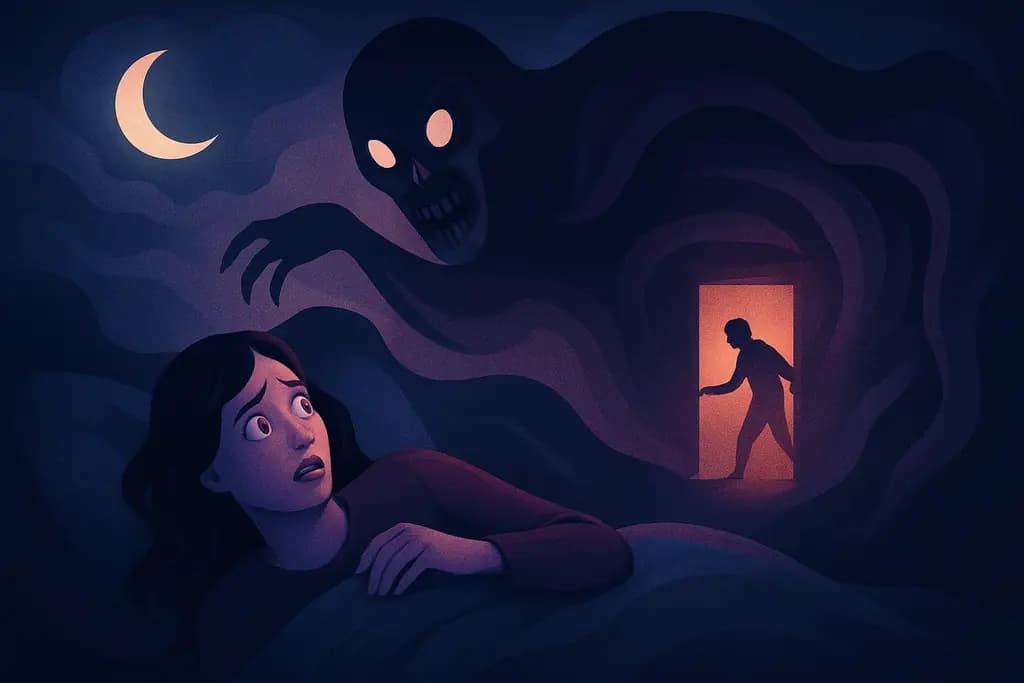
Boundary breach and personal limits. When the startling figure crosses a threshold—through a door, window, or screen—the dream commonly points to someone overstepping your limits or an internal line you’re avoiding. It may represent intrusive thoughts, an invasive relationship, or pressure you haven’t defended against. The emotional tone (humiliation, anger, panic) shows whether the issue needs confrontation, setting limits, or internal work.
What this dream is rarely about
This dream is rarely a literal prediction of violence or a concrete future event. It does not usually work as a direct warning that something identical will happen. Instead, it more often signals a psychological or situational surprise—an emotional boundary being tested. You might wake angry or relieved rather than enlightened; that emotional contrast is part of what the dream is processing.
Concrete details that tend to stand out
People report very specific visuals: a face behind a closet door, a stranger stepping out of a parked car in a rainstorm, the slam of a classroom locker, or a shadowy hand at a window—accompanied by a choking throat, cold sweat, and an animal-like jump in the chest.
When to take this dream seriously
Take a jumpscare dream seriously when it repeats, arrives during an extended period of stress, or follows a clear life transition like a move, job change, or breakup. Recurrence suggests the mind hasn’t resolved the underlying surprise; frequent vivid starts indicate ongoing tension. If the dream is linked to a specific waking event—an argument, a near-accident, a sudden loss—address that event directly (clarify facts, set boundaries, seek social support) rather than only analyzing the image.
Symbolic meaning across traditions
Meanings vary across traditions: some cultures see sudden apparitions as messages or omens requiring ritual attention, while others interpret them as ancestral warnings or signs of spiritual transition. In secular Western frameworks the emphasis is psychological; in other systems the appearance might be read as a prompt for ceremony, prayer, or communal consultation. Because beliefs differ widely, treat cultural readings as lenses rather than fixed answers.
Common questions
Is it related to stress?
Yes. Jumpscare dreams are often tied to stress—particularly sudden stressors or ongoing hypervigilance. They can bring forward the emotional reaction you haven’t yet had time to process.
Is this dream a warning?
Rarely as a literal warning. More commonly the dream highlights vulnerability or the need to prepare emotionally. Treat it as a signal to check what in your waking life feels intrusive or unstable.
Why do I feel fear in this dream?
Fear in the dream comes from the brain’s startle reflex and the resurfacing of an unresolved feeling—surprise, shame, or a crossed boundary. The dream provides an intense, condensed experience of that emotion so you can notice and respond to it.
Related dream meanings
If this dream keeps returning, pages about black Jumpscares, dream about Jumpscares, and Jumpscares can reveal the related patterns underneath it. They often overlap around insecurity, transition, or stress in everyday life. You may also want to compare it with Jumpscares biting me if the same mood or conflict keeps showing up.