What Does It Mean to Dream of Home?
People frequently report this dream when they are dealing with family pressure, conflict at home, or questioning your role in daily life. This dream is commonly associated with trust issues, family pressure, or relationship strain.
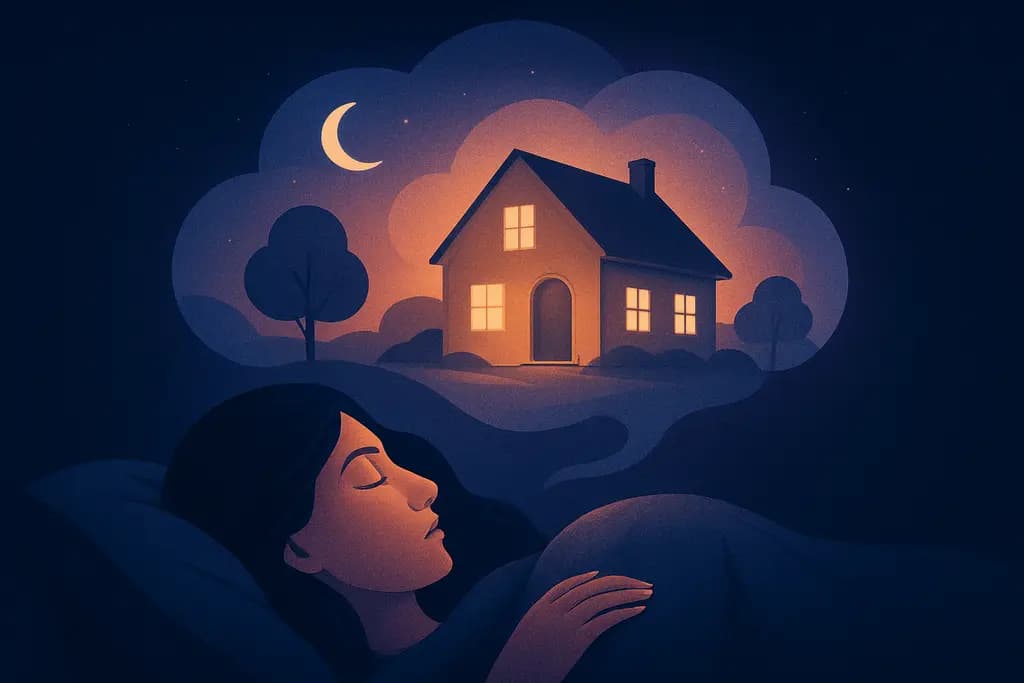
Category: Places
A typical dream scenario
You stand in a dim hallway that feels familiar — the light bulb flickers, the scent of lemon cleaning solution and old books hangs in the air, and a child’s drawing is taped crookedly to a door. Somewhere upstairs a clock chimes too loudly. You feel both the tug of comfort and a tightness in your chest, as if entering this place will ask you to face a decision you’ve postponed about who you are inside these walls.
Quick interpretation
A house in a dream commonly maps onto your sense of self and the relationships that define your daily life: rooms as roles, doors as boundaries, basements as buried concerns, attics as stored memories. Such dreams often appear during times when you’re re-evaluating family expectations, feeling anxious about safety, or negotiating a change in living situation or identity. Pay attention to which rooms are accessible, who is inside, and whether doors lock or open — those details point to which part of your life needs attention.
Key interpretations
Safety, boundaries, and current stress. If the house feels secure but you notice a locked door or a window you can’t open, the dream often points to current anxiety about safety or limits you’ve set with others. A locked room may represent a boundary you’re enforcing or avoiding; broken windows or drafts can indicate stressors that make you feel exposed. The emotional tone — relief, fear, or irritation — tells you whether those boundaries feel protective or constraining.
Family roles and belonging. Rooms populated by family members, or a house that’s arranged like your childhood home, tends to surface issues of belonging and inherited responsibilities. A crowded kitchen might suggest caregiving demands, while being ignored in a living room can reflect unmet recognition in family dynamics. This angle often appears when you’re relocating emotionally — negotiating old roles while forming a new sense of who you are in relation to others.
Endings, memory, and transformation. An attic filled with trunks or a basement filled with water typically points to memories, grief, or aspects of your life undergoing change. Clearing out rooms can symbolize letting go; collapsing floors or disappearing walls often reflect a larger transformation in identity or lifestyle. These images commonly arise during transitions like bereavement, divorce, moving house, or a career shift where a past part of life is ending.
What this dream is rarely about
This type of dream is rarely a literal prediction about selling or losing a particular house. It does not usually forecast actual property events. Instead, it commonly uses architectural features as symbols for personal boundaries, roles, or emotional history. An important nuance: feeling danger in the dream can express internal stress rather than immediate physical threat.
Unusual details people report
People often report striking sensory specifics: the wallpaper peeling in a childhood bedroom, a locked basement with a faint drip, rain pattering on a front porch, an echo of footsteps in empty rooms, or finding a familiar object like a broken chair or a forgotten photograph.
Psychological perspective
From a modern, neutral standpoint, houses function as visual metaphors your mind uses to organize experience: rooms sort feelings, doors register access, and objects hold narrative fragments. When you dream of home you may be processing attachment, boundary-setting, or role conflict without conscious rehearsal. This framing treats the dream as meaningful information about your priorities and emotional economy rather than a prophecy. If you’re anxious, notice which rooms trigger the strongest reactions — that’s where practical attention or conversation with loved ones may help.
Why recurring versions matter
If this dream repeats or returns during a stressful period, it typically signals unresolved fear, a recurring family dynamic, or an ongoing life transition that your waking routines aren’t addressing. Recurrence can indicate persistent uncertainty about boundaries, a cycle of caregiving fatigue, or unprocessed grief. When it keeps appearing, it’s useful to track changes in the dream across weeks: which rooms shift, who appears, whether doors become easier to open. Those shifts often mirror small, real-world decisions you can make.
Frequently asked questions
Is this about money?
Is this about money? Not usually. While an expensive or dilapidated house can reflect financial worry, most home dreams point to emotional boundaries, roles, or memories rather than literal financial forecasts.
Why does this dream repeat?
Why does this dream repeat? Recurrence usually means an unresolved emotional pattern — ongoing stress, a persistent family issue, or a transition you haven’t fully processed. The dream repeats until you address what it highlights in waking life.
Is this dream a warning?
Is this dream a warning? Not typically. It’s more often an internal signal highlighting an area of tension, responsibility, or loss. Treat striking details as prompts for reflection and practical action rather than imminent physical danger.
Dream meanings connected to this one
People who dream about home often end up exploring Journey, House, and Cages next, because the same pressure can show up through different symbols. Comparing them usually makes the emotional pattern clearer. You may also want to compare it with Darkness if the same mood or conflict keeps showing up.