Dream About Forests – Meaning
Category: Places
A typical dream scenario
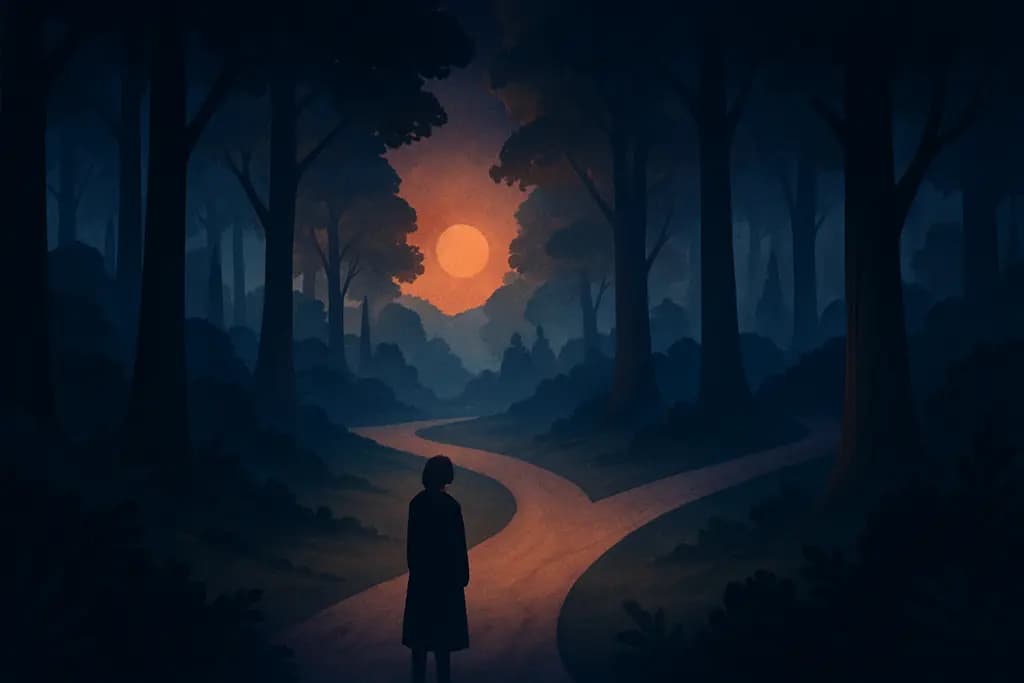
Direct answer: a forest dream most often signals you are navigating uncertainty or deeper emotions tied to a real-life choice. You might be walking through a damp pine stand at dusk, the ground soft with needles, fingernails skimming a moss-covered log as a forked path appears. Your chest is tight, you can’t find your phone signal, and a distant road hum reminds you of a job, relationship, or move that won’t stop demanding attention. The scene feels both familiar and uncanny, as if a private decision has been made public.
Concrete details that tend to stand out
People commonly report a specific door nailed to a tree, a stopped watch on a branch, sudden rain that soaks a coat, or a fox that watches without approaching. Sounds—distant machinery, children’s laughter, or boots crunching—often punctuate the quiet and make the forest feel threaded to ordinary life.
Main interpretation
A forest in dreams is commonly associated with complexity: it can reflect feeling lost among choices, a need to shelter hidden parts of yourself, or an invitation to explore what you’ve pushed aside. The dominant sense—panic, curiosity, calm—tilts the meaning: anxious wandering points toward indecision or fear; calm exploration suggests personal growth or creative searching; finding a clearing often marks clarity or resolution emerging in waking life.
Key interpretations
- 1. Lost and searching. If you felt disoriented, turned around, or kept retracing steps, the dream commonly signals confusion about a real-life choice—career direction, a relationship boundary, or where to invest your energy. The repeating forks and unclear trails mirror options you haven’t committed to; the emotional tone (frustration or fear) points to what’s blocking a decision. Practical step: map the options in waking life and pick one small test action.
- 2. Shelter and withdrawal. If the forest felt protective—soft light, a hollowed log, or a cabin—you may be seeking refuge from social demands, burnout, or persistent criticism. This angle suggests a need to create boundaries, rest, or process feelings privately. The dream often appears when you’re overwhelmed and need time to regroup, not when you should immediately confront others. Notice what you shelter there: grief, creativity, or aspects of identity.
- 3. Wildness and buried impulses. If animals, overgrown vines, or untended paths dominated the dream, it can point to impulses or memories you’ve kept out of view—anger, desire, or spontaneous parts of yourself. The forest’s untamed quality invites you to acknowledge and channel those energies rather than repress them. Look for moments in your waking life where you restrict expression; small, safe experiments can help integrate that energy constructively.
What it can reflect emotionally
From a modern, neutral psychological view, a forest dream commonly reflects internal conflict, decision-making processes, or emotion regulation struggles. It may appear during periods of ambiguity—job transitions, relationship shifts, or grief—or when memory cues trigger old patterns. In real life, bodily reactions in the dream (racing heart, slowed breathing) mirror how you physically respond to stress; noting those can guide practical coping steps like prioritizing rest, talking it out, or breaking decisions into smaller tasks.
What this dream is rarely about
This dream is rarely a literal prediction of getting lost in woods or encountering a wild animal. It does not usually work as a precise forecasting tool. Instead, the forest image typically stands for inner processes—decisions, boundaries, memories—rather than an imminent external event. Resist reading it as a direct warning about a future physical danger.
Why recurring versions matter
A single forest dream can be interesting; recurring versions matter because they often point to unresolved fear, chronic stress, or a life transition you keep revisiting. If the same scene returns—same path, same animal, same locked door—it flags an issue you haven’t processed: an unsaid conversation, a stalled decision, or a grief that needs space. Pay attention if frequency increases during high-stress periods; it’s a prompt to take tangible steps rather than ignore the feeling.
Common questions
What should I do after this dream?
What should I do after this dream? Note the strongest image and the feeling it carried, then take one small, practical step in waking life: schedule a conversation, set a boundary, or carve out an hour for reflection.
Why does this dream repeat?
Why does this dream repeat? It repeats when the waking issue—an unresolved decision, persistent stress, or unprocessed emotion—remains active; repetition signals the need for action or deeper processing.
Can this dream be positive?
Can this dream be positive? Yes. Calm exploration, finding a clearing, or guided movement through the trees often indicates personal growth, clarity emerging, or creative resources becoming available.
Is this dream a warning?
Is this dream a warning? Not usually as a literal warning. It can warn you metaphorically—about neglecting boundaries, avoiding choices, or ignoring stress—rather than predicting a physical event.
Related dream meanings
People who dream about forests often end up exploring Bad Weather, Ballrooms, and black waterfalls next, because the same pressure can show up through different symbols. Comparing them usually makes the emotional pattern clearer. You may also want to compare it with Cave if the same mood or conflict keeps showing up.