Dream About Crowd of faceless people – Meaning
Category: Fears & Nightmares
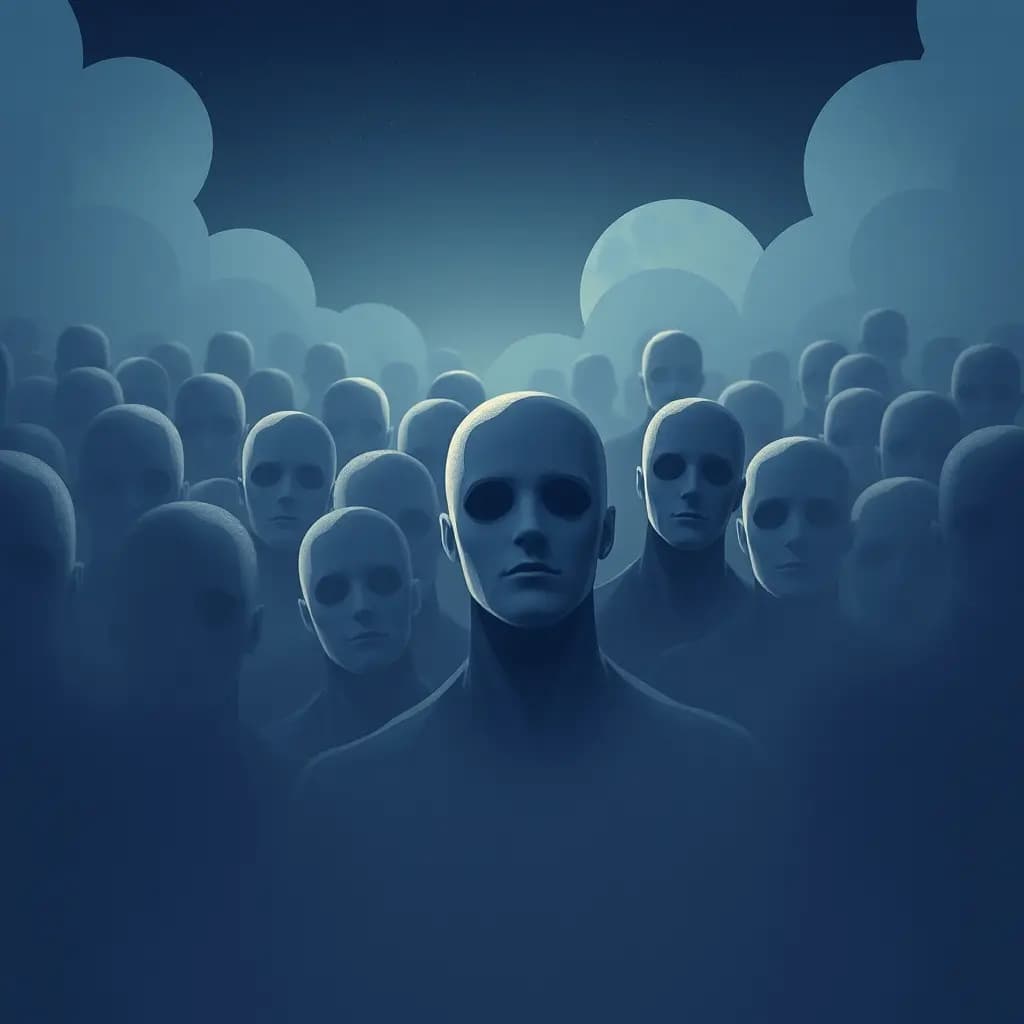
Dreaming of a crowd of faceless people often leaves you with a sense of unease, confusion or being lost in a mass. These dreams tend to surface when identity, anonymity or social pressure are on your mind. The meaning shifts depending on your emotions in the dream and the surrounding context — whether you felt threatened, invisible, or strangely calm.
General meaning of dreaming about Crowd of faceless people
At its core, a crowd of faceless people in a dream symbolizes anonymity, loss of individuality, and the sense of being swallowed by a collective. The facelessness strips people of personal markers, so the dream often points to areas of life where you feel unseen, indistinguishable, or pressured to conform.
This symbol can also point to internal fragmentation: parts of yourself that feel unknown or disconnected. In nightmares and fear-themed dreams, the faceless crowd frequently amplifies a sense of threat coming from vague, impersonal forces rather than a single identifiable cause.
- Feeling invisible or overlooked in social or work settings
- Anxiety about losing your identity or being forced to conform
- Overwhelm from group expectations or societal pressure
- Unintegrated aspects of the self or suppressed memories
- A sense of being judged by unknown others
Spiritual meaning of Crowd of faceless people in dreams
Spiritually, faceless crowds often represent collective energies or archetypal forces rather than individual souls. In many traditions this can point to the "shadow" — the parts of a person or culture that are hidden or denied — surfacing for attention and integration.
Some interpretations view the faceless crowd as a message about soul-level anonymity: a call to reclaim personal essence from social conditioning. Jungian ideas, shamanic views and many contemporary spiritual teachers all use similar language: the dream asks you to notice where you blend into the mass and to recover related aspects of your spirit.
Psychological interpretation
Fear, stress or anxiety
A crowd of faceless people can reflect generalized anxiety: fear without a clear object. When threat feels diffuse, the mind represents it as many indistinct faces. This often happens during high stress, major life transitions, or when you anticipate judgment but can't pinpoint who will judge you.
Relationships and emotional bonds
In relational terms, faceless crowds can signal emotional distance or disconnection. You might feel that people close to you are behaving impersonally, or that you are unable to see others' true selves. Alternatively, the dream may point to loneliness inside social situations — surrounded but not truly connected.
Control, power or vulnerability
These dreams can surface when control feels fragmented: either you fear losing agency within a group, or you sense others’ power over you is faceless and impersonal. The lack of distinct faces heightens vulnerability because there is no single accountable person to address or negotiate with.
Positive meaning
- Prompt to reclaim your identity and personal boundaries
- Opportunity to differentiate yourself from unhelpful group norms
- A call toward integrating hidden or suppressed parts of your personality
- Catalyst for creative expression that makes you stand out
- Sign that change is possible: facelessness can dissolve as awareness grows
Negative meaning and warnings
- May suggest growing social anxiety or feelings of invisibility
- Can indicate emotional dissociation or numbness when overwhelmed
- May point to burnout from roles that require constant blending in
- Can indicate risk of being manipulated by impersonal systems or groups
- May suggest avoidance of important personal decisions to keep the peace
Common variations of dreams about Crowd of faceless people
- Surrounded by a faceless crowd: Often reflects feeling overwhelmed or suffocated by social expectations; you may feel there is no personal space for your identity.
- Faceless crowd watching or staring: Suggests fear of judgment from unknown sources, or an internalized sense that you're being evaluated without clear feedback.
- Faceless crowd in a familiar place (work, school, home): Ties the anxiety to a specific environment where you feel you must play a role or hide parts of yourself.
- Unable to move through a crowd of faceless people: Indicates feeling stuck in life choices or blocked by anonymous systems and bureaucracy that prevent progress.
- Finding a recognizable face among faceless people: A hopeful variation that suggests emerging connection, guidance, or rediscovery of an aspect of self.
- Faceless crowd dissolving or fading: Often signals resolution or release — the fear or pressure is lifting as you gain clarity.
- Faceless crowd whispering or communicating silently: Points to subconscious messages or intuition trying to surface; listen for subtle cues in waking life.
- Faceless crowd pursuing you: A fear-driven variation that can reflect avoidance of responsibilities, decisions, or unresolved issues that feel like an advancing mass.
What to do after such a dream
- Reflect on the emotions you felt in the dream: fear, numbness, anger, or calm can change the interpretation.
- Journal details: location, actions, whether anyone became recognizable, and how you responded.
- Match dream imagery to waking situations: work dynamics, social groups, family expectations, or recent transitions.
- Take small practical steps: set clearer boundaries, assert preferences, or reduce exposure to draining group dynamics.
- Use creative practices (art, writing, movement) to explore lost or hidden parts of yourself that the crowd may represent.
- Share the dream with a trusted friend or a dream group to gain perspective and feel less isolated.
- If the dream is recurrent and causes ongoing distress or interferes with daily life, consider seeking support from a qualified counselor or therapist who can help you process underlying issues.