Dream About Counting money anxiously – Meaning
Category: Work & Money
What this dream often looks like
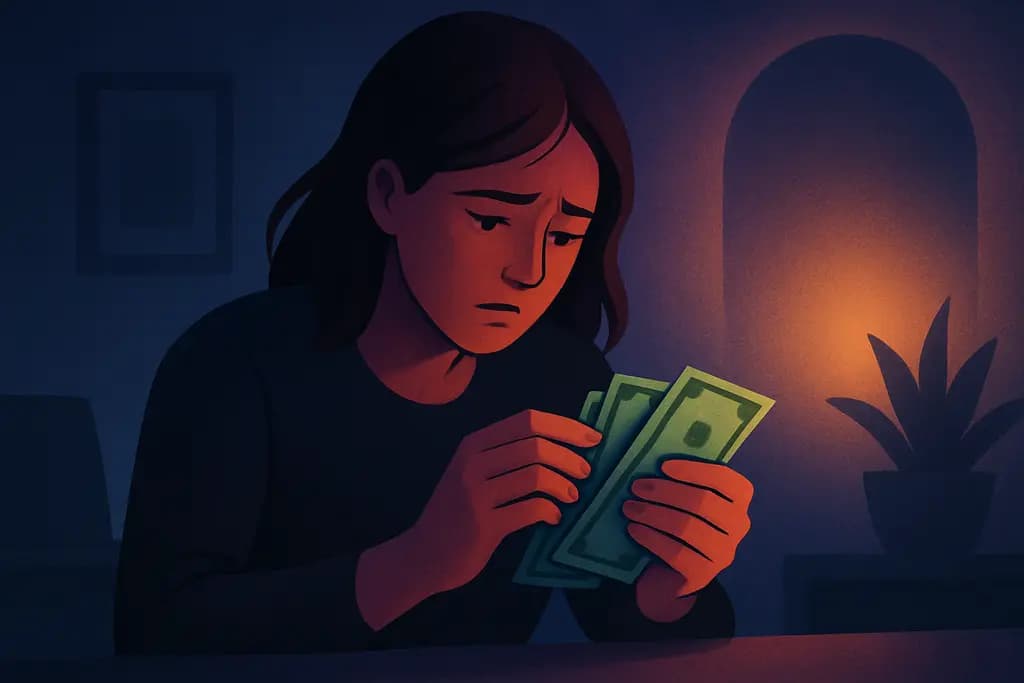
You are bent over a kitchen table under a single bright bulb, bills and loose coins fanned out, fingernails tapping as you count and recount. Your hands tremble; a missed bill makes your stomach drop. Sometimes the scene shifts — a crowded subway car, a bank teller’s window, or a damp alley — but the central action is the same: anxious tallying, a racing pulse, and the desperate need to make the numbers add up.
What this dream usually means
Direct answer: this dream most often signals stress about resources, control, or self-worth tied to work and money. It commonly reflects concrete worries — unpaid bills, an upcoming payday, or fear of job loss — and emotional reactions like shame, urgency, or hyper-vigilance. Details such as whether the cash belongs to you, a stranger, or your employer, and whether the total feels too small or strangely large, shift the emphasis between practical financial anxiety and symbolic questions of value and competence.
Key interpretations
- Immediate financial stress and practical shortage. If the dream focuses on making numbers add up and you wake worried about bills, it commonly reflects real, time-sensitive money pressure: overdue invoices, a tight budget month, or unpaid wages. The anxiety in the dream mirrors the practical cognitive load of balancing expenses, and the urge to recount suggests you’re mentally scanning for mistakes or missed income in waking life.
- Control, self-worth, and performance anxiety. When the counting feels more like measuring your worth — for example, tallying someone else’s money or being judged as you count — the dream often points to feelings of inadequacy at work, fear of evaluation, or a scarcity mindset where value is equated with earnings. This angle emphasizes identity: you might be asking, quietly, Am I enough? — and using money as the stand-in metric.
What this dream is not literally saying
This dream is rarely a literal prediction of how much money you will have or lose. It does not usually forecast a specific financial event or exact dollar amount. Instead, it translates current worries about stability and control into a vivid counting scene; emotionally charged symbolism often takes priority over literal forecasting. Think of it as a spotlight on stress, not a financial prophecy.
Concrete details that tend to stand out
People frequently report small sensory oddities: a ticking clock on the wall, a rain-spattered coat draped over a chair, coins clinking with an echo like distant laughter, or the smell of old paper. Other recurring images include an unlocked safe, a cashier’s voice estimating totals, or numb fingertips that won’t hold the bills steady.
What it can reflect emotionally
From a modern psychological viewpoint, this dream can reflect acute cognitive and emotional strain: worry about scarcity, an overactive monitoring system, and anxiety-driven perfectionism. Counting is a checking behavior; repeating it in sleep mirrors daytime rumination and the brain’s effort to resolve uncertainty. The dream can also show locus-of-control issues — whether you feel able to influence outcomes — and may surface during periods of tight budgets, job transitions, or after a mistake that threatens financial standing.
When this dream deserves attention
This dream deserves attention when it repeats, coincides with real financial decisions, or leaves you waking in panic. Recurring anxious counting suggests an unresolved problem that won’t fade with time — unpaid debts, an unstable job, or internalized scarcity mindset. If the dream begins to color daytime mood, lead to avoidance, or show up before major moves (taking a new job, signing a lease), use it as a cue to review finances, set a simple plan, or talk with a trusted adviser; the dream is signaling something practical and emotional that needs addressing.
FAQ
Is this dream a warning?
Is this dream a warning? Not usually a literal warning; it commonly signals current worry about security or a need to take practical steps—review budgets, confirm pay schedules, or address a looming expense—rather than predicting a specific event.
Is this about relationships?
Is this about relationships? It can be. Counting someone else’s money or feeling judged while tallying often points to exchange dynamics—fairness, dependence, or resentment—within partnerships, family, or workplace relationships.
Why does this dream repeat?
Why does this dream repeat? Repetition generally reflects unresolved anxiety or ongoing practical stress—continued financial strain, chronic perfectionism, or a persistent scarcity mindset. The dream repeats until the underlying worry is acknowledged or addressed.
Dream meanings connected to this one
If this dream keeps returning, pages about Bank vault full of money, Bankruptcy or Losing Money, and Counting coins can reveal the related patterns underneath it. They often overlap around insecurity, transition, or stress in everyday life. You may also want to compare it with Finding an endless pile of money if the same mood or conflict keeps showing up.