Dream About Caves – Meaning
Category: Places
What this dream often looks like
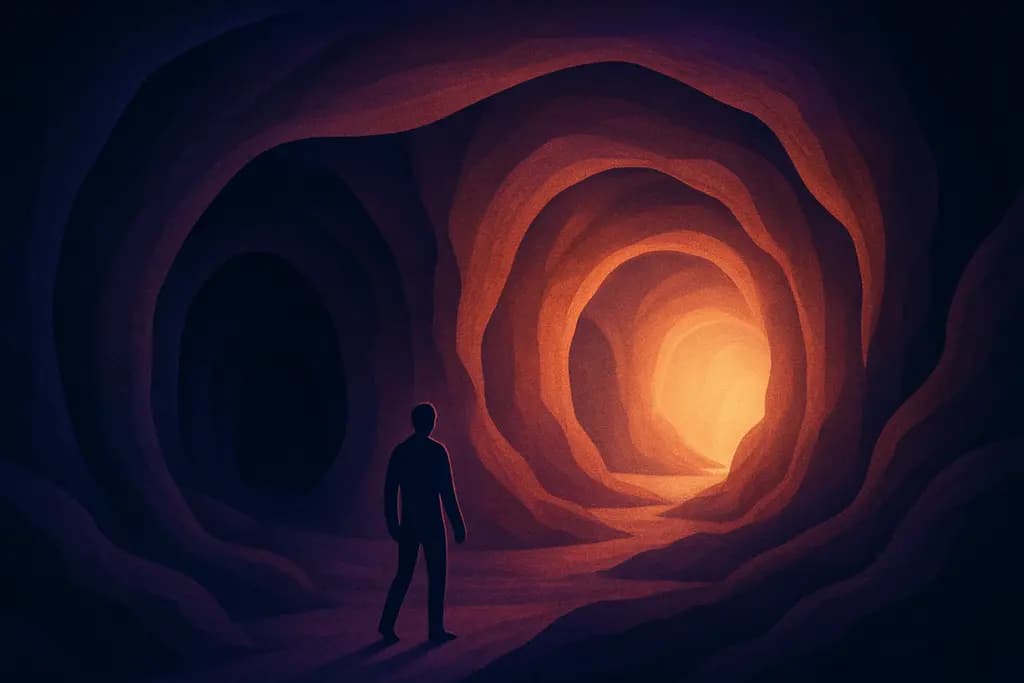
You find yourself ducking under a low, wet overhang; your boots are muddy and cold, a single hand-held torch sputters as you move into a cavernous chamber. Water drips from stalactites onto an old wooden chest at your feet. You feel both claustrophobic and curious — a pulse of panic in the throat, then a stubborn, steadying focus on the next passage. The dream follows a particular life moment: leaving a job, ending a relationship, or deciding to stop avoiding a difficult memory.
Specific details people often mention
Dreamers commonly report specific items: a rusted iron door at the cave mouth, the echo of distant traffic, bats stirred by your torch, a small wooden ladder, a child’s shoe beside a pool, sudden cold on one cheek, or the metallic taste of fear at the back of the mouth.
Key interpretations
Hidden feelings and unresolved memories. A cave often stands for what you have put out of sight. If you find old papers, a locket, or a familiar face in the cave, the dream commonly points to memories or emotions you’ve avoided—grief, regret, or a childhood scene. This interpretation is practical: the dream is asking you to name what’s inside so it loses power. A concrete step might be writing down the image you found and noting when you last felt that same emotion in waking life.
A safe retreat or a blocked path. Depending on the mood — peaceful hush versus breathless claustrophobia — the cave can mean shelter or stagnation. A warm, candlelit chamber suggests a temporary, nourishing withdrawal where ideas incubate; a choke of falling rocks suggests obstacles you haven’t faced. Look at recent choices: have you withdrawn to regenerate, or are you avoiding decisions? The dream may nudge you to test the exit — a small, doable step toward change.
Spiritual and symbolic perspective
In many symbolic traditions, descending into a cave is an initiation motif — a temporary withdrawal to meet a deeper self and return changed. The cave can be read as a liminal space where inner wisdom, creative insight, or spiritual renewal emerges. This perspective is offered non-dogmatically: it suggests the dream may be an invitation to silence, attention, and symbolic ‘descent’ for inner work. For some, the cave feels like a cavern for prayer or contemplation; for others it’s simply a stage for psychological integration.
Psychological perspective
From a modern psychological angle, cave dreams often reflect internal processing: consolidation of memories, rehearsal of difficult conversations, or the mind’s attempt to integrate fragmented parts of identity. The imagery — tight passage versus open chamber — maps onto how constrained or resourced you feel. This framing is not a clinical diagnosis; it's a neutral way to consider motivation and coping: are you conserving energy to recover, or is avoidance undermining progress? Consider practical experiments: a short period of solitude with a journal, or scheduling one action you’ve been postponing.
What this dream is rarely about
This dream is rarely a literal prediction of physical danger or a specific future event; it does not usually work as a direct forecast. People sometimes assume a cave dream means an imminent disappearance or a real-life trip into underground places. Instead, treat it as symbolic processing — emotional signals rather than a factual timeline. There can be tenderness under the tension: the dream may feel alarming while also inviting curiosity.
What to ask yourself
- Where in the cave did you go first, and does that place remind you of a specific memory or decision in waking life?
- What object, sound, or temperature in the dream felt most significant, and when did you last feel that sensation while awake?
- After waking, what impulse did you have first — to explore more, to leave quickly, or to call someone?
FAQ
Is it related to stress?
Yes, cave dreams are often related to stress. They commonly reflect withdrawal, processing, or feeling overwhelmed; the cave’s tone—safe or claustrophobic—helps indicate whether the stress is prompting rest or avoidance.
What should I do after this dream?
Start simply: write three concrete details from the dream and one feeling word. Then choose one small action (call a friend, tidy a space, set a 10-minute journal timer) that responds to that feeling.
Is this about relationships?
They can be about relationships if someone from your waking life appeared or if the cave scene echoed a pattern in a partnership — for example, withdrawing when conflict arises. If no person appears, it may point to internal needs rather than another person.
Is this dream a warning?
Not usually. A cave dream is rarely a literal warning about future events. It’s more commonly symbolic—signaling emotional issues, a need for rest, or a prompt to face something you’ve been avoiding.
Dream meanings connected to this one
If this dream keeps returning, pages about Bad Weather, Ballrooms, and black waterfalls can reveal the related patterns underneath it. They often overlap around insecurity, transition, or stress in everyday life. You may also want to compare it with Cave if the same mood or conflict keeps showing up.