Dream About Canyons – Meaning
Category: Places
What this dream usually means
When responsibilities or relationships feel like an impossible gap, canyon dreams often point to deep emotional separation or a big turning point. The canyon’s depth commonly reflects how large or entrenched a problem feels; steep walls signify obstacles or fears that make crossing seem risky. Crossing, descending, or finding a bridge in the dream may indicate you’re ready to take measured action, while standing on the rim often signals that you’re weighing options and scanning the safest path before committing.
A common version of this dream
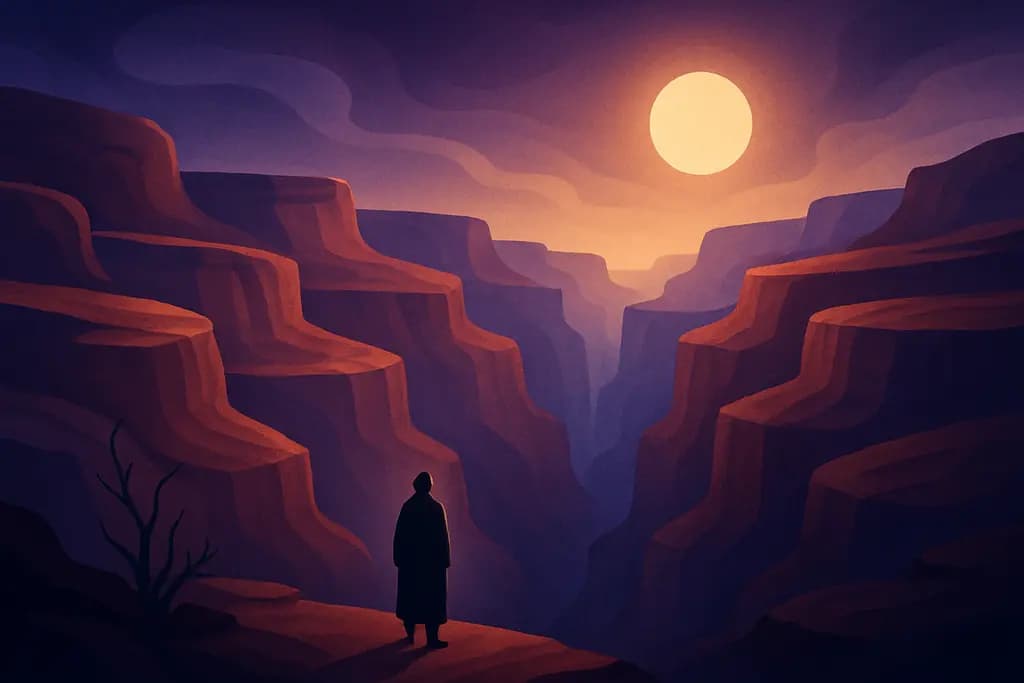
You stand on the rim at dusk, the canyon below carved into shadows and sunlit terraces. Wind tugs your jacket; dust smells like dry earth. A narrow trail zigzags down and a frayed rope bridge sways between two sheer walls. Someone — a partner, a boss, or a parent — calls your name from the far side. Your heart thumps, and you test the first step, feeling both dread and a strange pull toward the drop.
What this dream may be expressing
- Inner Divide: unresolved relationship distance. A wide canyon often points to emotional separation from someone important — a partner, family member, or close friend. The walls represent barriers like unspoken resentments, pride, or timing; the presence of a trail or bridge shows you’re contemplating ways to reconnect but also measuring emotional risk. If you find a crossing, the dream may signal readiness to repair trust; hesitation at the edge suggests fear of rejection or missteps.
- Risk and Decision: weighing a major life choice. When a canyon appears during a period of career change, moving, or a big commitment, it commonly reflects the perceived hazards of that choice. Steep drops and loose footing point to uncertainty about outcomes; a steady bridge or rope ladder may show you have resources or a plan to cross if you act deliberately. Falling or backtracking in the dream suggests doubts that need practical addressing before you commit.
- Loss and grieving: processing absence or endings. Descending into a canyon or standing in its shadow can represent the interior work of grieving: the canyon’s floor is where memories lie, and narrow passages can mirror the painful, slow paths through loss. Echoes, empty campsites, or scattered belongings in the dream often mean specific memories are surfacing. Movement toward the bottom suggests you are facing the grief; lingering at the rim suggests avoidance.
- Perspective and growth: seeing life from a new vantage. A canyon’s sheer scale can also encourage perspective: the panoramic view from the rim may reveal what small choices matter and what patterns repeat. Crossing or building a bridge symbolizes problem-solving and growth; returning to the rim feeling lighter suggests gained insight. This interpretation emphasizes learning — the canyon challenges you but also offers a broader outlook if you engage with it.
What this dream is rarely about
A canyon dream is rarely a literal roadmap or a direct prediction that you will travel to a specific place. It does not usually warn about a particular physical event. Instead, the scenery is symbolic of inner distances, patterns of avoidance, or necessary effort; vividness reflects emotional intensity, not factual forecasting.
Concrete details that tend to stand out
People frequently notice small, vivid things: the creak of wood on a rope bridge, a parked truck at the rim, the smell of cold rain, a torn sleeve catching on a rock, or a distant echo of children’s laughter. These concrete sensory details — clothing soaked, gravel slipping underfoot, or a door half-buried in the canyon wall — tend to stay with dreamers after waking.
Cultural and symbolic views
Meanings vary across cultures and should not be treated as universal. In some Indigenous stories, deep gorges and river cuts carry specific ancestral and landscape-based lessons tied to place and community; in Jungian terms, they can represent the unconscious. Other traditions use canyon-like imagery to describe spiritual descent and rebirth. Respect local cultural narratives and personal background when weighing symbolic meanings — a canyon in your dreams will resonate differently depending on your cultural lenses and lived experience.
Personal reflection prompts
- Which relationship or choice in my life right now feels separated by a gap I’ve been avoiding?
- What practical resource or small step would make crossing that gap safer and more possible this week?
- When have I successfully crossed a difficult divide before, and what did that process teach me about taking the first step?
Common questions
Is this about money?
Is this about money? — Rarely a direct indicator of finances. A canyon can symbolize perceived scarcity, risk to resources, or the size of a financial decision, but it usually points to emotional stakes rather than literal wealth.
Is it related to stress?
Is it related to stress? — Yes. Canyons commonly surface during stress or transition, highlighting pressure, anxiety about outcomes, or feeling overwhelmed by the scale of a problem.
Can this dream be positive?
Can this dream be positive? — Yes. While it can feel frightening, a canyon dream often contains constructive elements — bridges, trails, or successful crossings — which suggest growth, new perspective, and readiness to act.
Dream meanings connected to this one
If this dream keeps returning, pages about Bad Weather, Ballrooms, and black waterfalls can reveal the related patterns underneath it. They often overlap around insecurity, transition, or stress in everyday life. You may also want to compare it with Cave if the same mood or conflict keeps showing up.