Dream About Book (reading or finding books) – Meaning
Category: Objects
A typical dream scenario
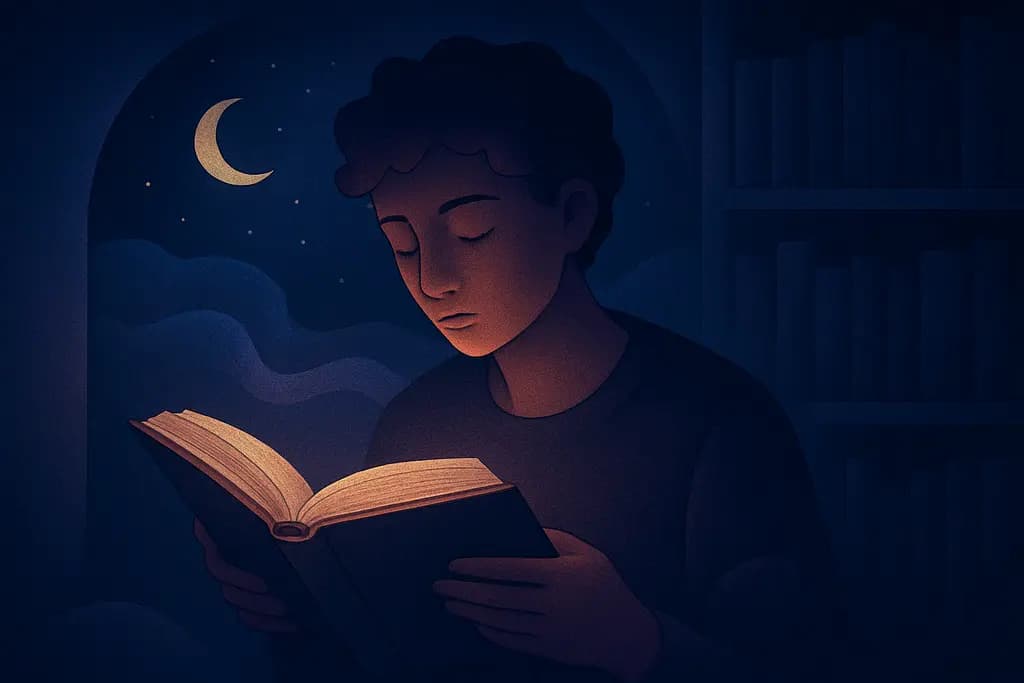
Direct answer: this dream often signals you're searching for information or a new chapter in life. Picture yourself in a quiet, sunlit room, pulling a slim blue book from a stack on a kitchen chair. Your hands are slightly trembling with curiosity; the cover is warm from the afternoon light. You sit down, leaf through pages that smell faintly of dust and lemon, and a name or phrase on the margin stops you — a small shock of recognition that feels both comforting and urgent.
How this dream can be interpreted
- New learning or a skill you’re ready to take on. If you were calmly reading instructions, a textbook, or focused prose, the dream often reflects readiness to learn something concrete — a course, a job skill, or a new hobby. The calm attention in the dream usually matches an awake willingness to study or practice. Consider whether you’ve been postponing a class or avoiding a manual; this dream can be an inner nudge toward active preparation.
- A life chapter opening or closing. Finding a book tucked between moving boxes, or reading a passage about departure, tends to indicate transitions: a relationship cooling, a career shift, or a relocation. The book becomes a metaphorical chapter marker. Emotions in the dream — relief, grief, or anticipation — point to how you’re responding to that change. Practical step: identify what chapter you’ve been living and what might come next.
- Unearthed memory or hidden details about yourself. An old, handwritten book or a volume with your name scrawled inside suggests that forgotten memories or personal insights are resurfacing. This interpretation fits if the pages contained intimate notes, recipes, or family stories. The dream may be guiding you to examine family history, buried feelings, or patterns you haven’t acknowledged.
- Guidance when facing a decision. Finding a book labeled with a question or a manual in a moment of uncertainty can point to the inner search for rules, ethics, or a mapped-out solution. You may be looking for a moral compass, career roadmap, or parenting guide. The tone of the text you read — prescriptive, lyrical, or ambiguous — mirrors how confident you feel about following external advice versus trusting your own judgment.
What this dream is not literally saying
This dream is rarely a literal prediction of a single future event and does not usually function as a direct prophecy. It does not mean you will literally discover a physical secret tomorrow. Interpretations that assume the dream is a plain forecast are likely to miss the more useful symbolic message about learning, memory, or decisions. Emotion in the dream (relief, dread, curiosity) remains more informative than assuming a one-to-one prediction.
Unusual details people report
People often report very specific imagery: an attic with a single skylight, rain on the window while pages flutter, the distant rumble of a train as they read, or a small black cat curling on the lap. Some dreamers notice distinct smells — old glue, citrus, or mildew — and a quick pulse in the wrist when they find a particular sentence.
Spiritual meaning
From a spiritual angle, a book in a dream may be read as a symbolic record of soul lessons, an inner scripture, or a message from a guiding presence. In some practices the book represents an inner teacher; in others it’s a mirror of karmic lessons or ancestral wisdom. This perspective can be helpful if you treat the dream as an invitation to reflect or ritualize: for example, meditating on the phrase you read or noting it in a dream journal. Keep interpretations tentative and rooted in what resonates for you personally.
Psychological perspective
Psychologically, reading or finding a book often reflects cognitive processes: integrating new information, reorganizing personal narratives, or retrieving memory traces. The dream may surface when your brain is consolidating learning, rehearsing choices, or trying to make sense of fragmented experiences. Notably, the emotional tone — calm absorption versus panic — signals whether you’re processing information with confidence or feeling overwhelmed. Practical follow-ups include summarizing the dream, mapping it to current decisions, and testing small steps toward the insight the dream hints at.
Questions to reflect on
- What exact phrase, image, or title from the book stuck with you, and where else have you seen it in your waking life?
- Did the dream place the book in a particular room, vehicle, or outdoors setting, and what current area of your life maps to that location?
- What emotion did reading or finding the book produce, and what action would shift that feeling in waking life?
Common questions
Is this about relationships?
Is this about relationships? — Not usually strictly about relationships, though a book might contain messages about a partner or family history. If the dream emphasized names, letters, or dialogue, consider whether it reflects new understanding or unresolved stories involving someone important to you.
What should I do after this dream?
What should I do after this dream? — Write down the book’s details and any striking phrases, then reflect on where that information might apply (work, study, family). Follow up with a small, concrete step: look up a term, ask a question, or read one relevant article.
Is this about money?
Is this about money? — Generally no. Only if the book contained clear financial symbols (ledgers, bills, bank forms) should you read the dream as money-related. Otherwise the dream more often concerns knowledge, decisions, or personal history.
Dream meanings connected to this one
Dreams about book (reading or finding books) are often connected to Balloons, Bicycles, and Bikes. Looking at those nearby themes can help you compare control, fear, pressure, or change across similar dream scenes. You may also want to compare it with black lost objects if the same mood or conflict keeps showing up.